Pokewalker · Creatures as data
A Pokémon made of maths
Give it a Pokémon's sprite sheet and it hands back the Pokémon as shapes: outlines, a skeleton it found on its own, and moves it can do. Nothing is hand-rigged. The same few kilobytes draw it at any size, in any line style, in any pose.
A sprite is a grid of coloured squares. It cannot bend its tail, turn its head or curl into a ball. Everything a sprite does, an artist drew frame by frame.
So the walker now reads a sprite the way an animator would. It traces each part as smooth outlines, works out where the body, head, tail and limbs are, and puts a skeleton inside. From then on the creature is data: curves on bones, drawn fresh on every frame.
The skeleton finds itself
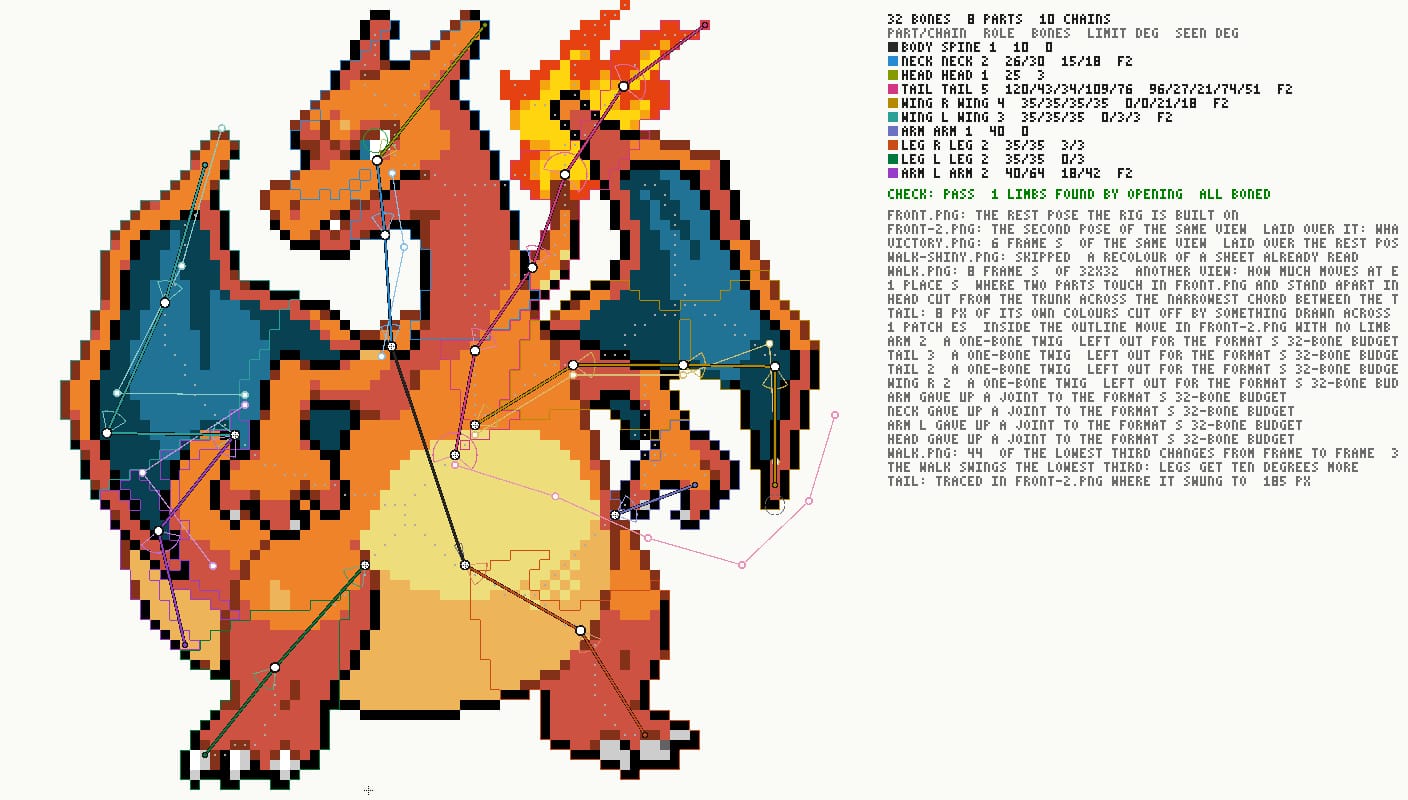
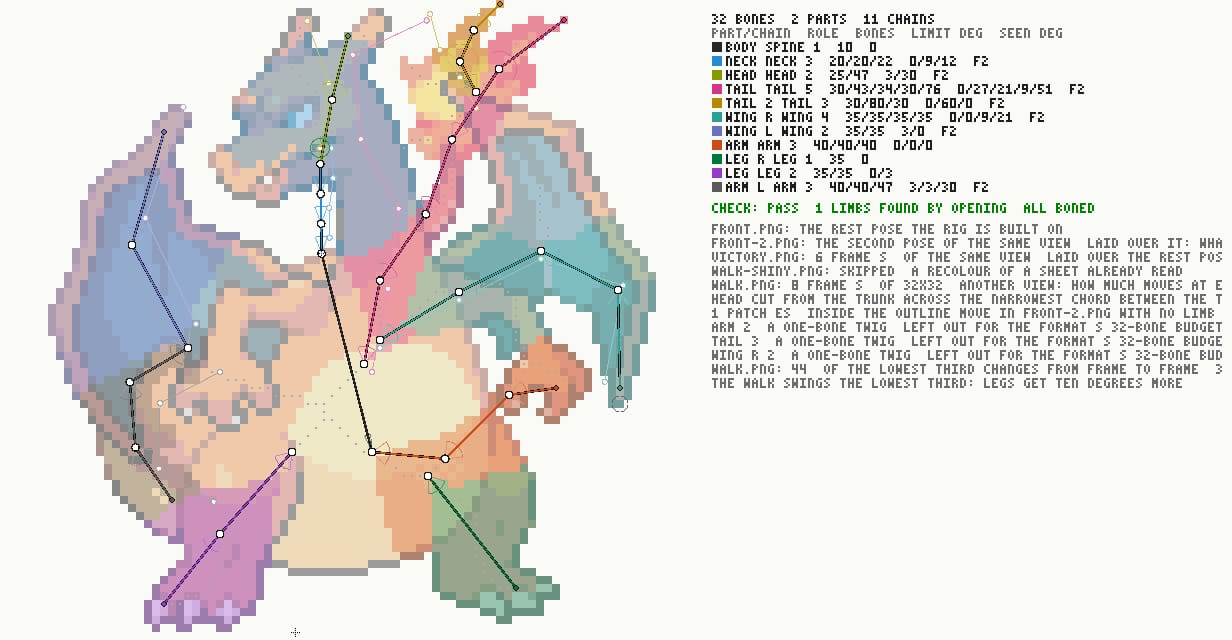
Nobody placed these bones. The rig comes from the sprite sheet itself. The front view gives the rest pose. The game's second frame, laid over it, shows what moves and how far. The 32×32 walking sprites show how much moves at each joint as it walks.
Each chain gets a role (spine, neck, head, tail, wing, arm, leg) and a limit for every joint, so a wing can sweep but an elbow cannot fold backwards. The format has a budget of 32 bones. Charizard hits it, so a few one-bone twigs are left out and say so in the table.
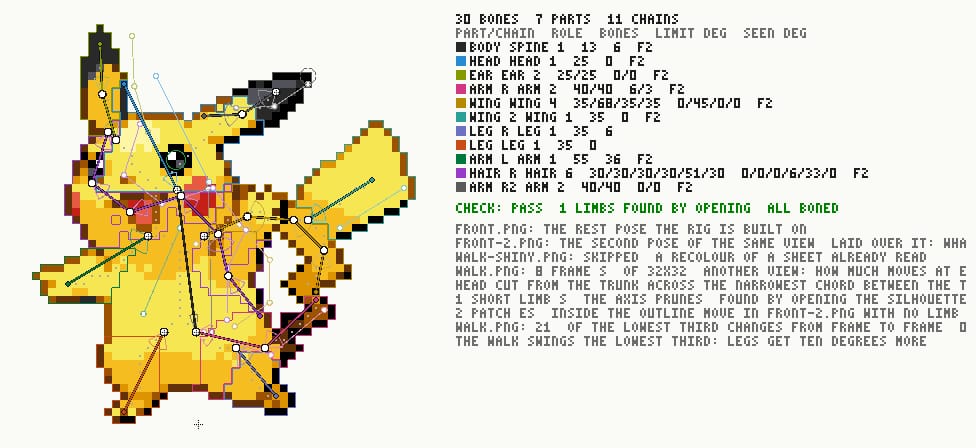
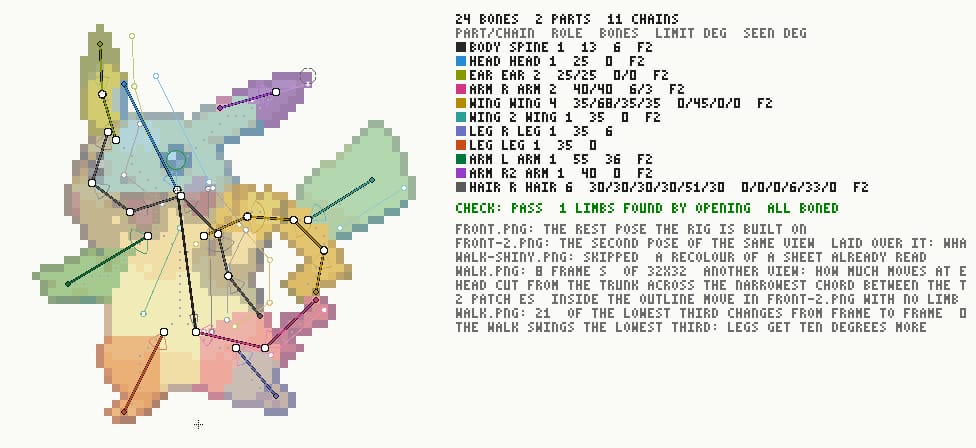
Pikachu gets the same treatment from the same code: 30 bones, the ears as their own chains, the zigzag tail as a long one.
Eyes are their own check
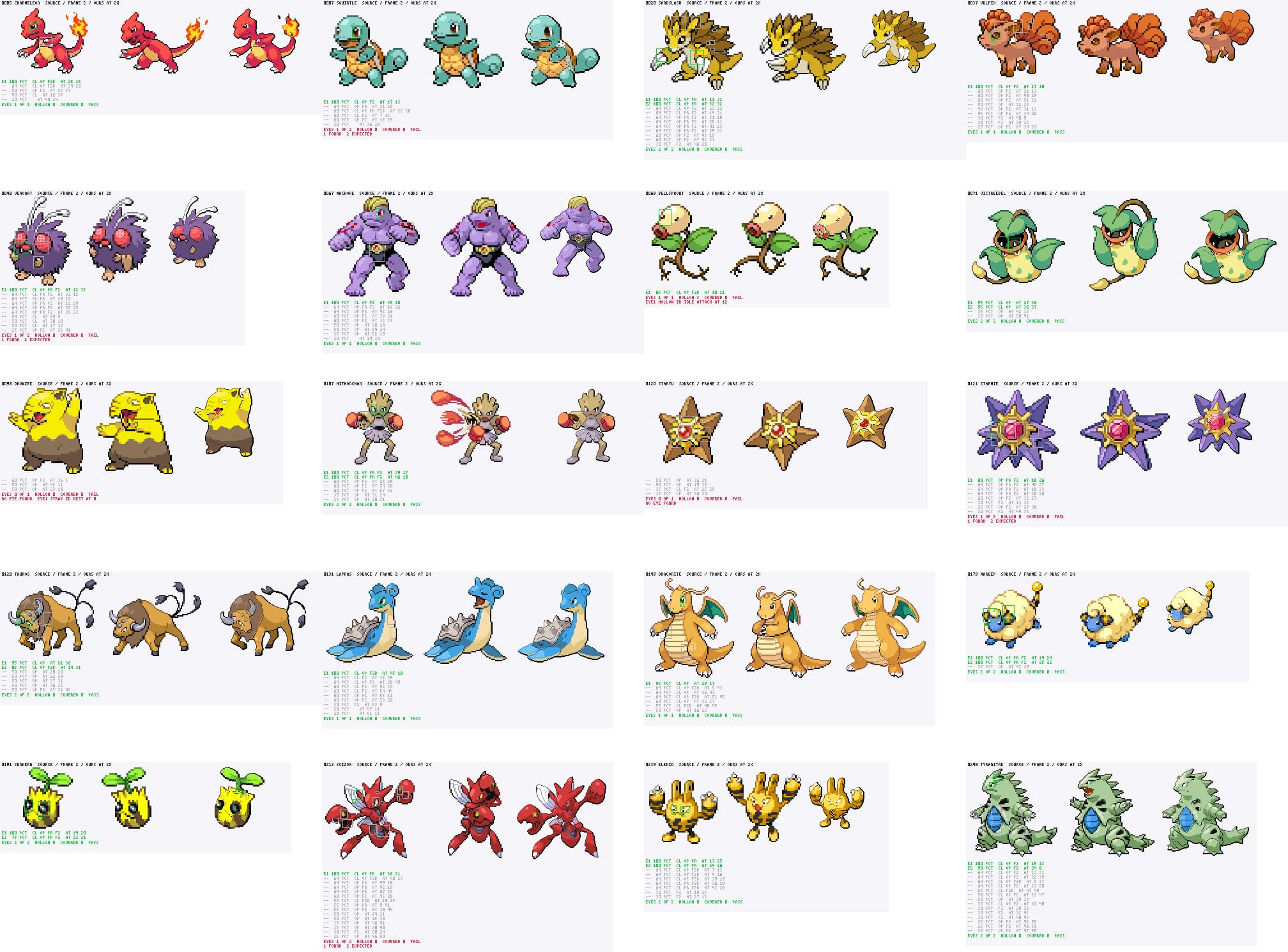
An eye is a dozen pixels out of a thousand. Lose one and the outline still matches almost perfectly, but the creature looks dead. So eyes are checked on their own: found, not hollow, and not covered by another part in any pose of any move. A creature that fails is not finished.
Finding eyes is the hard part. The finder is right on about three species in five. Here it is across twenty random ones, with each species' boxes and verdict.
Moving, and redrawn
Once there is a skeleton, a move is a set of eased curves on bones over time. Moves are written once and work on any creature: a jump and spin, a bounce, a look round, a slow tail swish, a sleepy sway, and now a ball spin, where it curls up, spins with sparks and lands.
Because nothing is stored as pixels, the line style is a choice made at draw time. These two clips are the same data drawn bold and thin, side by side.
Small enough for the walker
Charizard as shapes is 14.5 KB, Pikachu 8.1 KB and Bulbasaur 5.2 KB, each covering both of the game's frames and every move. The renderer that draws them is integer-only and allocates nothing while drawing, so it runs on the walker's own chip, not just on a desktop.
What it cannot do yet: the back of Charizard, built from tiny 32-pixel walking frames, is still rough, and the eye finder misses two species in five.
The sprites the creatures are built from come out of the owner's own cartridges when the software is built, and no repository stores any of them. Pokémon is Nintendo's.
← Back to devlog