Pokewalker · Battle engine
Dodge left, take double
Every turn both Pokémon pick a move and, in secret, a stance: jump left, hold, or jump right. An aimed attack fires down one lane. Stand in it and you take double. Leap into it and you take double. Get one lane clear and you might still be clipped by the edge.
Battles with a mind game in them
Underneath, these are Generation 1 battles: the same stats, damage formula, type chart, critical hits, status conditions and switching as Red and Blue, for all 151 Pokémon and 165 moves.
On top sits a field with three lanes. Each turn, both sides choose a move and a stance at the same time, and neither sees the other's choice until both are locked in. Then everyone lands, and the attacks fly.
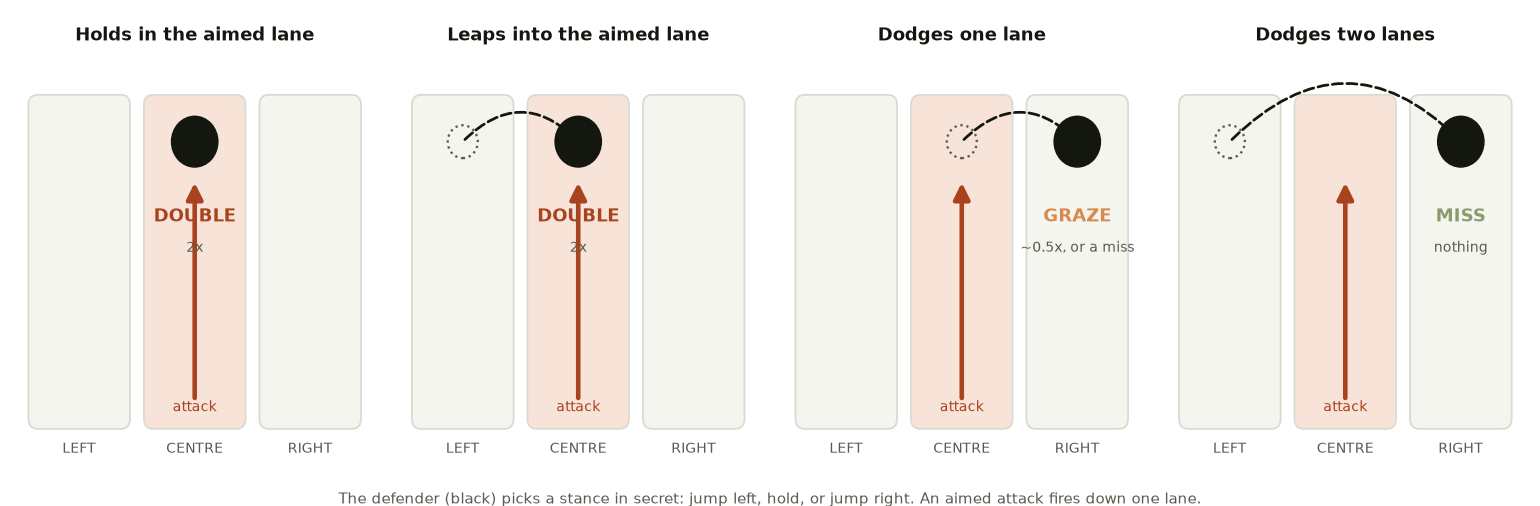
What an attack does
Moves come in shapes:
- Aimed moves, like Thunderbolt, Flamethrower or Body Slam, go down one lane. A Pokémon in that lane takes double. One lane over, it is usually grazed for about half. Two lanes over, it is missed.
- Wide moves, like Surf, Earthquake and Razor Leaf, hit their lane and the lanes beside it, at three quarters of their power.
- Centre bursts, like Fire Blast and Pin Missile, hit their lane in full and always catch the lanes beside them with the edge.
- Follow moves, like Swift and Psychic, track the target and never miss, but never land for double either.
The Pokémon matter as much as the lanes. A fast one sometimes clears two lanes in a single leap. A heavy one takes less from a graze. And a Pokémon that jumps attacks off balance, at three quarters of its power. Without that cost, the evasive trainer won 58% of matches and everyone would have played that way.
A turn, as the engine writes it
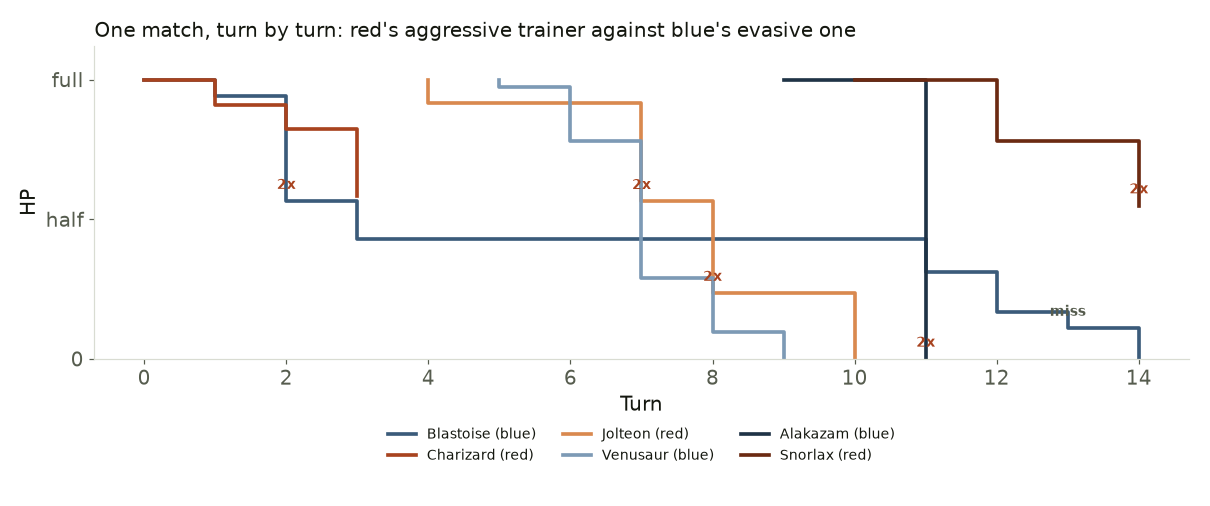
This is turn 11 of a match between an aggressive trainer and an evasive one. Snorlax has just come in for red. Alakazam is nearly untouched.
-- turn 11
SNORLAX jumps left -> centre
ALAKAZAM jumps left -> centre
SNORLAX uses DOUBLE-EDGE (Aimed) at the centre lane
  -> DOUBLE on ALAKAZAM: 130 damage, 0 HP left
  SNORLAX Recoil 32 (203 left)
  ALAKAZAM faints!
Alakazam read Snorlax as coming left and jumped to meet it, straight into the lane the Double-Edge was aimed at. Full health to fainted in one strike, even with Snorlax swinging off balance.
Two turns later the same trick failed. Blastoise, on 17 HP, jumped clear and Snorlax's Double-Edge went through an empty lane:
-- turn 13
SNORLAX holds the right lane
BLASTOISE jumps centre -> left
SNORLAX uses DOUBLE-EDGE (Aimed) at the right lane
  -> MISS on BLASTOISE: 0 damage, 17 HP left [dodged clean]
Twenty thousand matches
A twist like this is easy to get wrong. If dodging is too strong, nobody ever stands still. If it is too weak, nobody bothers to move. So the engine plays itself: three against three at level 50, every combination of tactics against every other, with the teams swapped each time so only the tactics decide.
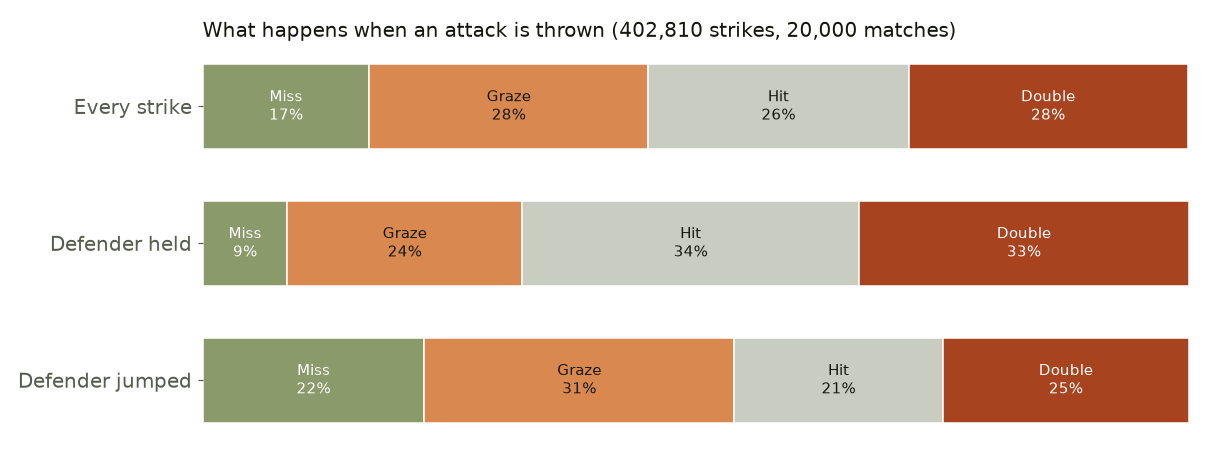
Across 402,810 strikes, a little over a quarter land for double and about the same share are grazes. A Pokémon that holds still is hit far more often. One that jumps is missed far more often, and still takes double a quarter of the time, because the other trainer guessed where it would land.
Football Manager, not Street Fighter
You don't press buttons every turn. You set tactics, the way a manager sets team instructions:
- Temper: aggressive, balanced or evasive.
- Dodge bias: favour left, favour right, or mix it up.
- Reading: punish a Pokémon that keeps holding, or predict where it will jump.
- Switching: pull a Pokémon out at low HP or a bad type matchup.
- Move priority, per Pokémon.
The AI plays from those, using only what both trainers can see, including how each Pokémon has jumped so far. In a live match you are on the touchline with a handful of direct orders to spend. In an automated one, you watch the replay afterwards and change your instructions.
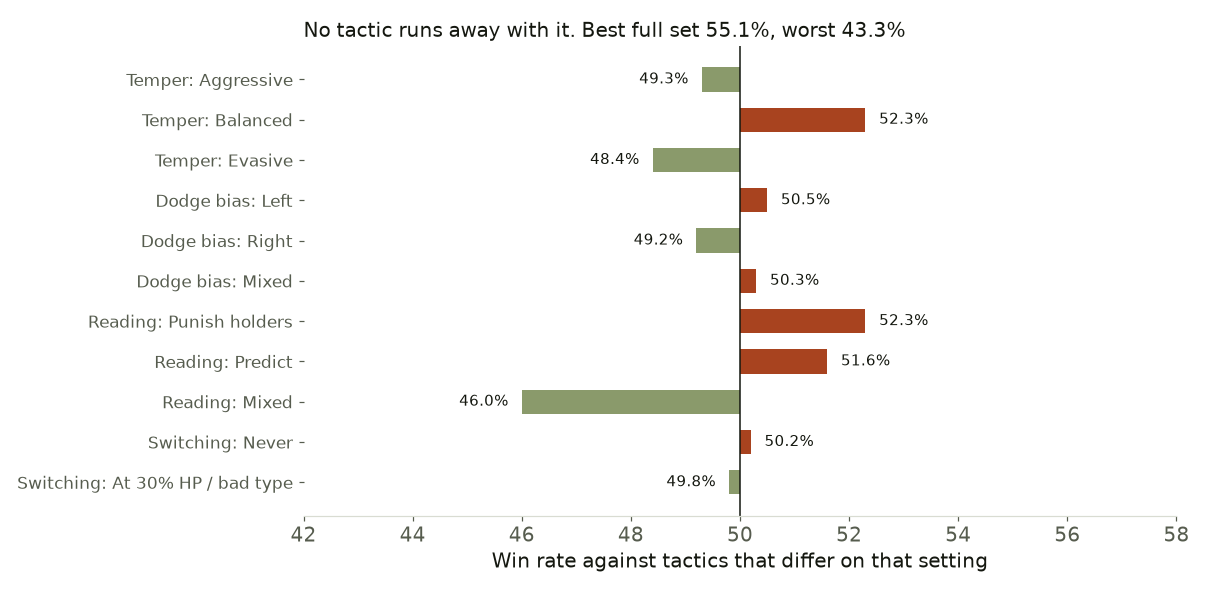
The test that matters is whether any setting wins on its own. None does. The best complete set of tactics wins 55.1% of its matches and the worst 43.3%. A match lasts about 16 turns.
The same battle everywhere
The engine is a small Rust library with no floating point and no dependencies. The same code will run on the walker, in a browser and on the server that hosts online battles, and a given seed plus both trainers' choices produce the same result on every one of them. Five hundred simulated battles came out byte for byte identical on a PC and in WebAssembly.
That means a battle never has to be sent as video. A whole match is the random seed, the two teams and each turn's choices: about a hundred bytes. The walker downloads that and replays the fight itself.
Still to come
Nine Generation 1 moves aren't in yet: Counter, Bide, Mimic, Metronome, Mirror Move, Transform, Conversion, Disable and Substitute. Wrap and its kin do their damage but don't trap yet. When a Pokémon faints, the next one in line comes in.
Next is the part you see: the two Pokémon facing each other on the walker's round screen, jumping between lanes, with the real move animations aimed at wherever the target ends up.
The engine runs in simulation on a PC and in a browser; it builds for the walker's chip but has not run on the board yet. Species and move numbers are Generation 1's, read from the pret/pokered disassembly. Pokémon is Nintendo's.
← Back to devlog