Pokewalker · Creatures as data
New moves from a sentence
Type "a person flaps both arms up and down like wings" and a few minutes later a 32-pixel Charizard is flapping. Not every sentence survives the trip from a human body to a small dragon, and the ones that don't are worth seeing too.
Yesterday's creatures came with a handful of moves written by rule: a jump and spin, a bounce, a look round, a tail swish. Rules are good at small, tidy motions. They are bad at anything with weight and timing, like a body crouching, leaping and catching itself.
That is exactly what text-to-motion models are good at. Kimodo is one of them: NVIDIA's Kimodo model, ported to plain C++ by the LocalAI folks. You give it a sentence and a length, and it gives back a skeleton moving at 30 frames a second. It runs on an ordinary CPU, which is all I wanted to spend on it.
The catch is that it writes motion for a person. Thirty joints, two arms, two legs, a head on a neck. Charizard has wings, a tail, stubby arms and a follower sprite 32 pixels tall.
A person, seen from one side
The trick is to stop thinking in 3D. A follower is never seen in 3D: it is a front, a side or a back, drawn flat. So the human is filmed from one of those directions, and each limb becomes an angle on the screen.
From the side, the hips-to-neck line becomes Charizard's lean, the legs become its legs, and the way the body rises and falls feeds a lagging sway down the tail. From the front, the arms become arms and the shoulders lift the wings. Which view to use is picked from the motion itself: lots of forward-and-back limb movement means side on, lots of side-to-side means front on. When a limb points straight at the camera it has no usable angle, so it holds its last good one rather than flicking about.
Five sentences, onto the follower as the walker already rigs it:
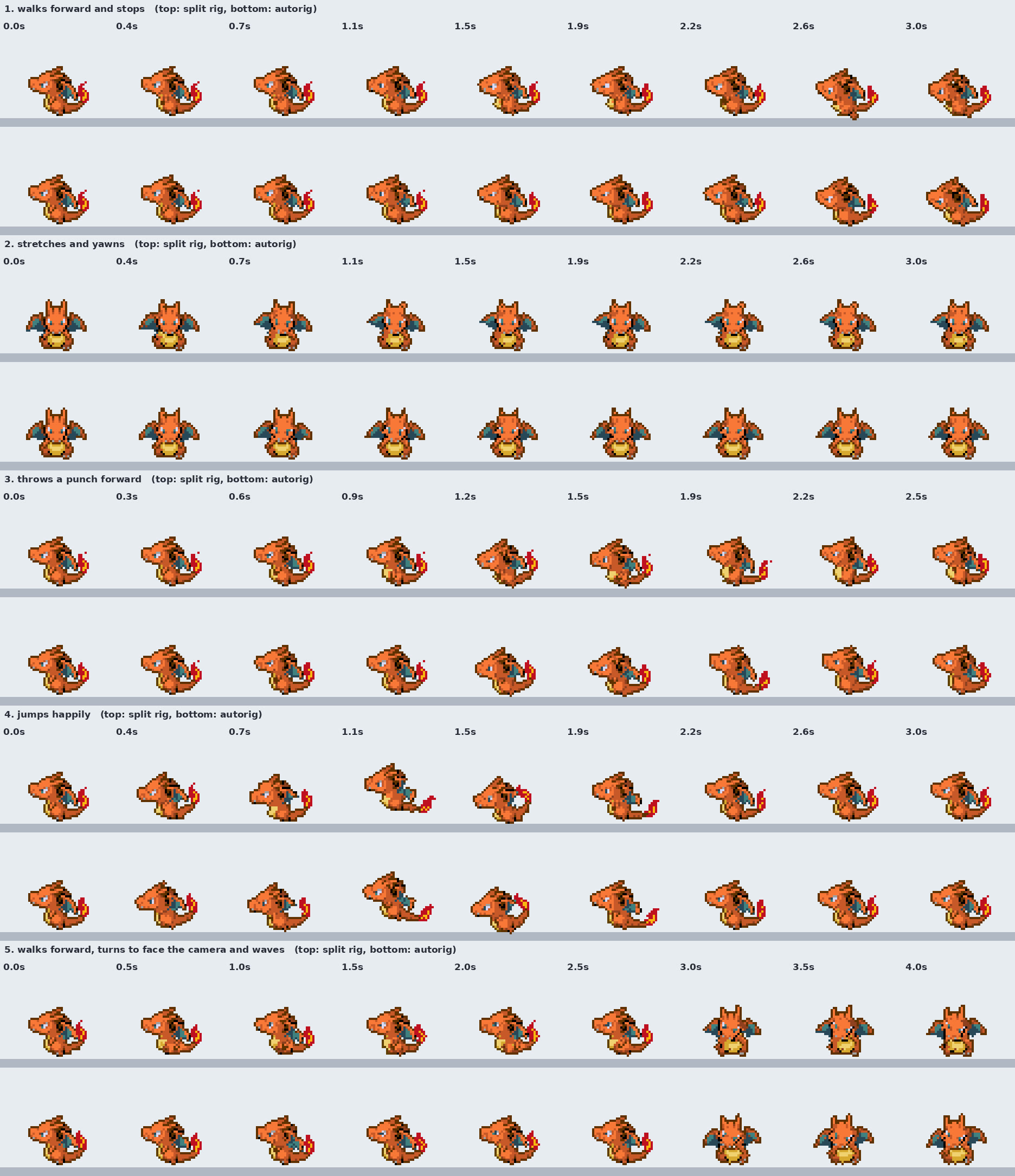
The jump is lovely. He crouches, throws himself up and back, and the tail whips after him. Walking forward and stopping reads well too, because the stop is in the whole body.
The punch, the stretch and the wave do almost nothing. They are arm moves, and a follower's arm is three or four pixels. There is nothing there to throw a punch with.
It lost to our walk
The obvious next question was whether Kimodo should simply take over the walk. It is a real walk cycle from real motion data. Ours is two drawings swapped every 170 ms.
Ours wins. A human walks at a human pace, and on a creature this small that pace looks sluggish, like wading. The legs don't help either: at 32 pixels the feet are not separate enough to plant one and swing the other, even with the legs cut out by hand. The two drawings were made by an artist who knew all that and cheated accordingly.
What Kimodo did add was the lean into each step and the sway of the tail. Nice, but not worth giving up a walk that already works.
It won at flying
Flight is a different story. The flyer is seen from behind, and today it flies by swapping two poses every 150 ms. From behind, a person flapping their arms maps straight onto a pair of wings: how high each arm is drives that wing, and each segment further out trails a frame or two behind, so the wing bends through the stroke instead of hinging.
The glide is my favourite. Tilting the shoulders becomes a bank, so he leans into a turn, holds it, and leans out the other way. Nothing in the rule-written moves does that.
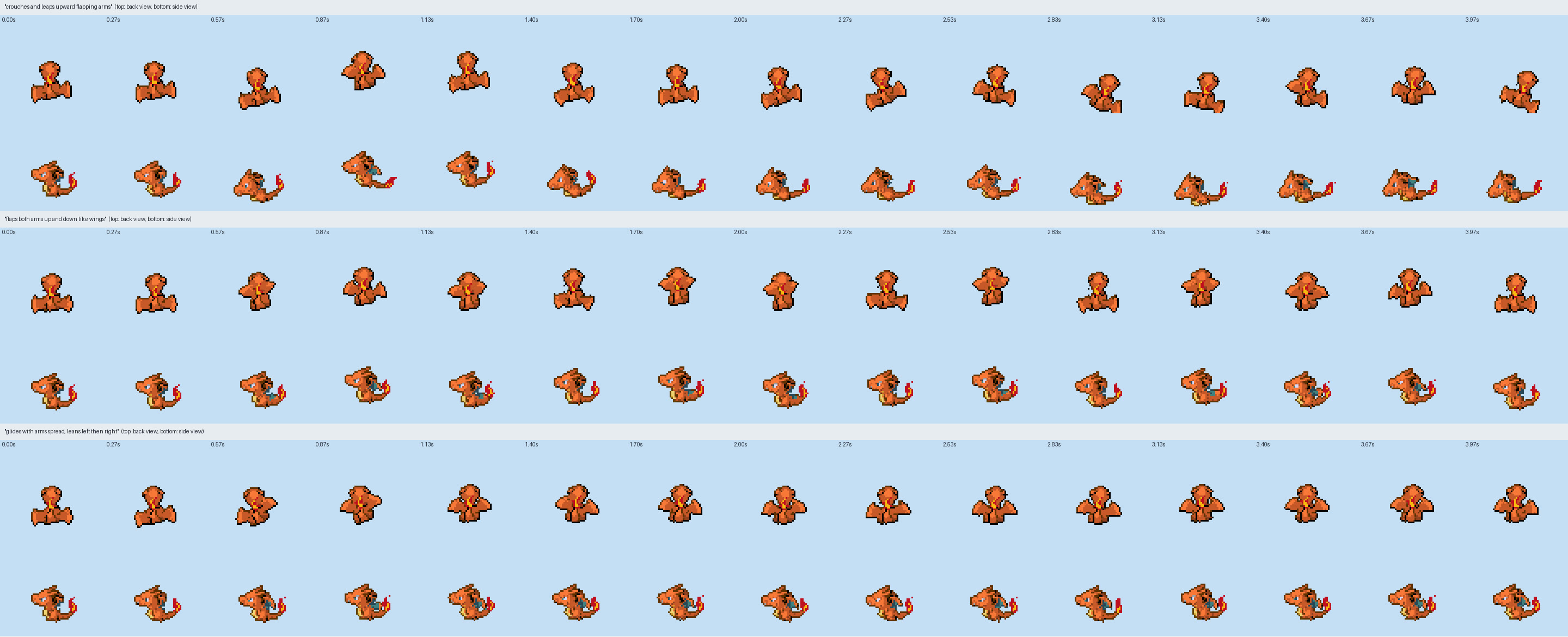
Take-off nearly works. The crouch and the leap read well. Then the person it came from lands, because people do, and Charizard pitches forward into a nose-dive. A take-off for a dragon wants a sentence where nobody comes back down.
A tool for new moves, not a replacement
So that settles where it fits. Kimodo doesn't replace any move the walker makes for a creature. It adds new ones next to them: a flap, a glide, a jump, a celebration. You write the sentence, look at the result on the actual creature, keep it if it reads, and throw it away if it doesn't. Throwing one away costs about a minute.
That minute is the real cost. A four-second clip takes around 75 seconds on all the cores of a desktop CPU and holds about 2.5 GB of memory while it thinks. The text model is the heavy half, so it loads two layers at a time instead of all of them, and a watchdog kills the run if the machine starts running short. Nothing about it goes near the walker itself: what comes out is just keyframes on bones, the same as every other move.
The scripts live with the rest of the creature tools, and I've kept a fork of kimodo.cpp so the build we used stays buildable. Next is the obvious one: a proper take-off, and some sentences written for a dragon rather than a person.
Every Pokémon here is the walker's maths version, drawn from shapes and bones. The sprites they were built from come out of the owner's own cartridges at build time and no repository stores them. Pokémon is Nintendo's.
← Back to devlog