AgentGB · Recognisers
Teaching a network to notice
The student plays Pokémon Blue from the screen and nothing else. The scaffolding around it did not — five small triggers answered their questions by reading the cartridge, which is cheap, exact, and a lie about what the student can do. Replacing them with networks that look at the picture took two days, and every measurement that was supposed to catch the mistakes said everything was fine.
The student plays from four stacked 36×40 greyscale frames in, one of six buttons out. That constraint is the whole point of the project, and for months the scaffolding around the student quietly broke it.
The scaffolding is a set of small triggers — a battle has started, this is the
forest, our lead is hurt — that decide which trained behaviour drives the next
decision. Each one used to answer its question by reading the cartridge: wCurMap for
the forest, wIsInBattle for the battle, the party HP struct for the heal. Point it at
a different emulator and none of those reads exist.
Over two days, 2026-09-02 and 03, five of them were replaced with networks that look at the picture. Every one of the five was harder than it looked, and the ways they went wrong are more useful than the fact they now work.
What a recogniser is
A recogniser is the smallest thing this project trains. Two classes, one question — is this the screen? — over the same observation the student gets, or a crop of it. You give it a pile of frames that are the scene, a pile that are not, and hold some back to score it on.
Size follows the crop, and the crop matters more than anything else here. A full-frame recogniser is 118,290 parameters. Cropped to the band under the opponent's name it is 28,178; to the lead's HP bar, 24,082; to the top half of a text box, 6,954.
None of them touch the student. models/pixel-student.npz is 122,330 parameters and was
not retrained once during any of this — same file, sha256 b2bb79082c88c486…, before
and after.
Held-out accuracy lies
The first forest attempt was a single classifier for is this Viridian Forest. It scored 1.0000 balanced accuracy on frames it had never seen, and then fired on 37% of 1,705,090 real play frames. Raising the bar did not save it: 15.5% still fired at 0.999.
This is structural, not bad luck. A closed two-class network puts everything it has never seen into whichever class is broader, and the held-out split is drawn from the frames it was shown — so it cannot contain the failure by construction. For a question like "which place is this", the broader class is the positive one, and the recogniser converges on yes.
The fix is not a better classifier. It is a different question. A place is a scene, and a scene has no edges. A doorway is an event, and an event has a beginning. Recognise the event.
The probe lies too
So you probe: run the trained recogniser over every corpus on disk and count how often it fires where it should be silent. The forest-entry trigger came back with zero false alarms across 1,705,090 frames of 19 links.
It then fired inside the player's own house, at p >= 0.999, in 19 of 20 live cold-boot runs. Because that goal holds until an exit trigger clears it, one such fire strands the run for good: a paired N=20 read 0/20 against 11/20 for the version it was replacing.
Both numbers were correct. A link's corpus stops at its map change, because that is when its goal fires, and the next link's corpus starts after it. The cross-map stack — three frames of the old room, one of the new — is exactly what a door produces and exactly what this recogniser was trained on, and it exists in no ordinary corpus at all.
A check cannot find a fault in a place it was never shown. Anything whose subject is a transition has been measured against data that structurally cannot contain its worst confusion. The repair was a shard of 4,825 cross-map door fades from six other doors in the opening chain, collected on purpose and used as a probe target.
The stack drags the last room in with it
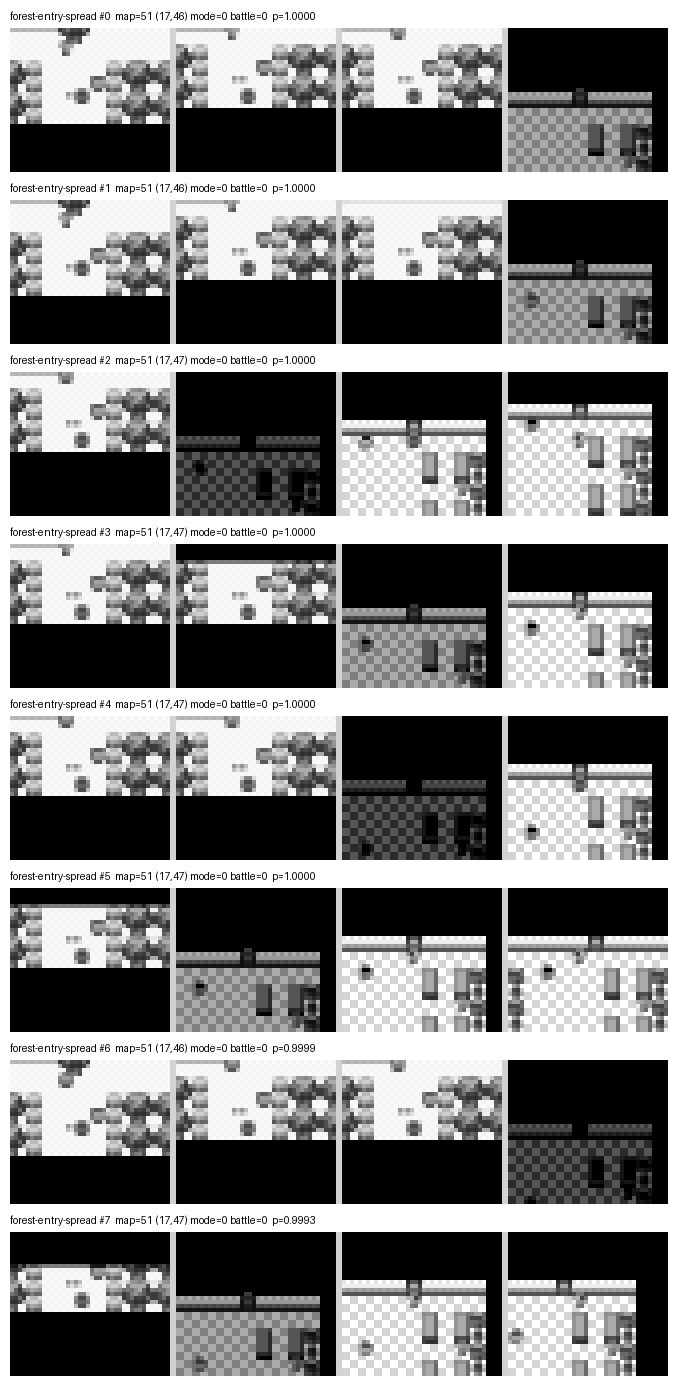
Look at the right-hand frames. They are indoors.
The observation is four frames, so "the first frame of the forest" physically carries three frames of the room before it. Measured on the crossing shard: of 600 rows labelled map 51, the oldest channel is the gatehouse in 450, and only 150 are forest in all four. Three quarters of what the first recogniser was taught to call forest entry was mostly indoor-building pixels — which is precisely why it fired in a house.
The fix is to keep only frames whose four channels are all the target map. Three steps into the forest is the first decision with no gatehouse anywhere in the stack, and across 150 runs it produces just four distinct pictures. That is a fixed shot, not a spread, which is what makes it worth recognising.
The exit is the same trick pointed the other way — the north door, on the way out.
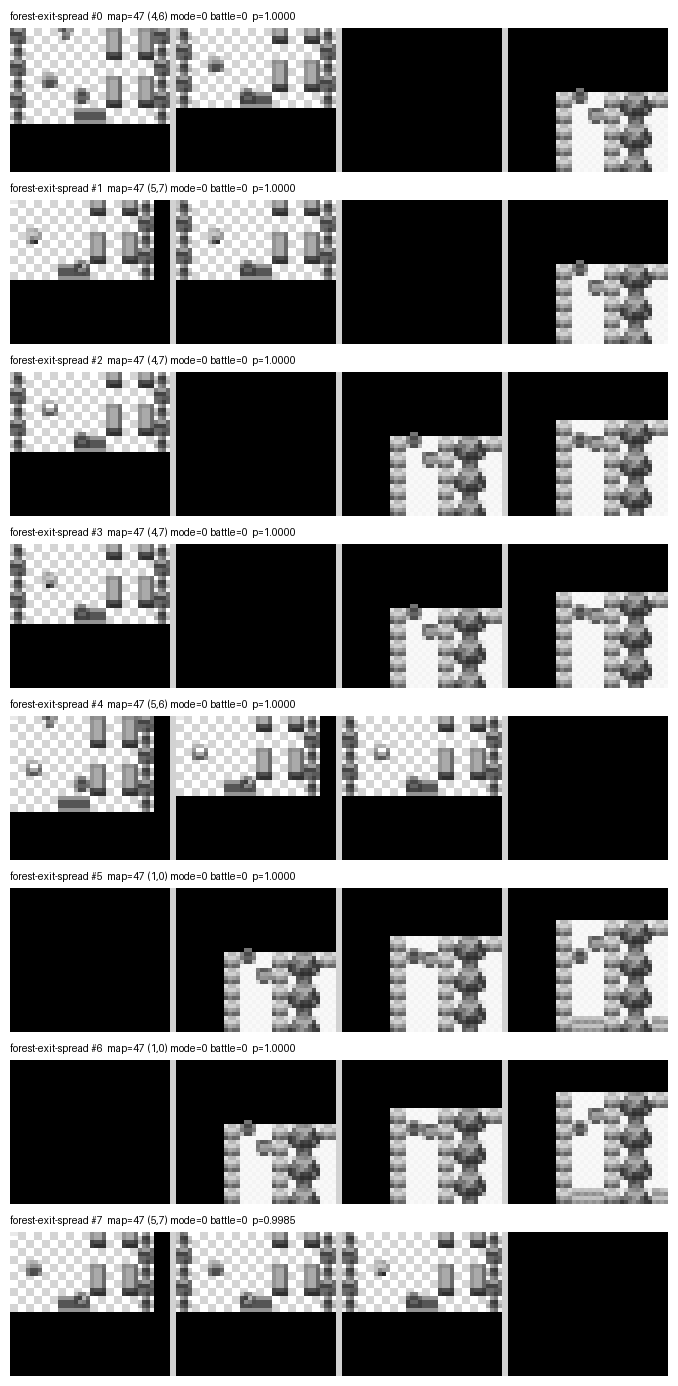
Its threshold is 0.99, not the 0.999 the entry uses, and the difference was measured rather than chosen. At 0.999 the exit misses 37 of 152 real exits. A trigger tuned only for silence goes blind; this project has already lost 11 of 27 runs to one that only ever saw a fully drawn line of text.
A screen-only trigger, taught by a memory read
This is the one worth the whole page.
The battle gate was trained on every frame where the cartridge byte wIsInBattle said a
battle was happening — --positive-select "battle=1". It reads nothing but pixels when
it plays. Its positives were chosen by reading memory.
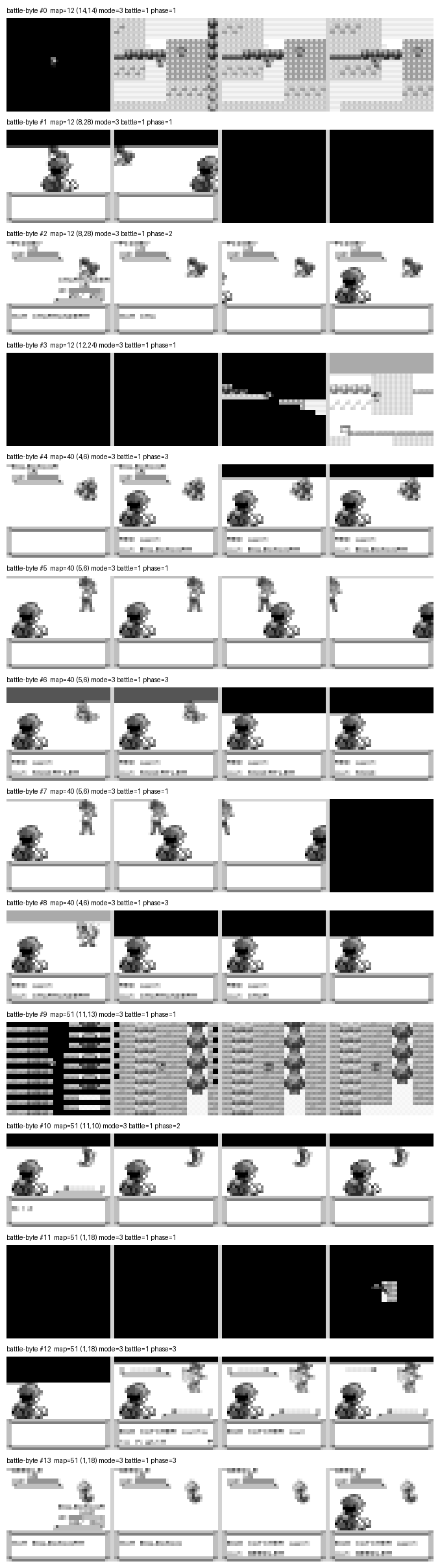
The byte and the screen do not agree. On a wild encounter the byte flips a decision before the screen changes; on a trainer battle it flips about six decisions after the entry wipe has started. So the pile contains frames that are not battle screens.
Chosen by the byte · poisoned
Chosen by the phase · honest
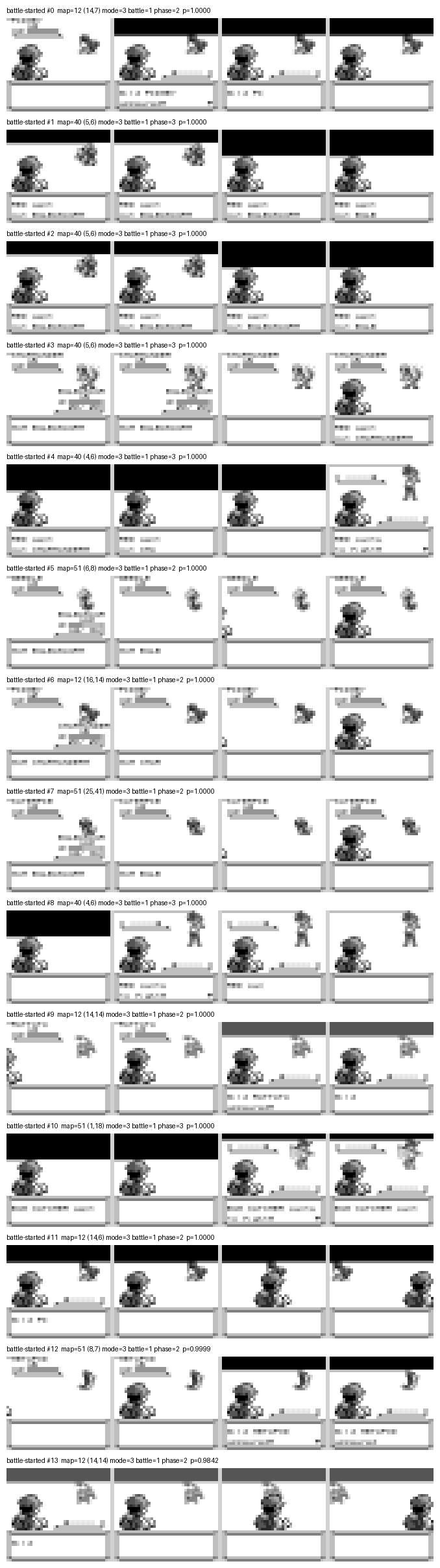
Across the whole pile: 1,572 of 3,632 selected rows are the entry wipe, and 1,130 of them — 31.1% — contain at least one entirely black frame. The gate was being taught that a battle is on screen includes the screen is black, which is also every door fade in the game.
The numbers never showed it. Held-out balanced accuracy 1.0000, every one of 227 genuine battles caught at every threshold, and a stubborn floor of a handful of false alarms per half-million frames that four rounds of patching, a wider patch budget and more epochs all failed to move: 8, then 2, then 5, on different links each time. Not a threshold problem, not a capacity problem. The label.
The repair was a new per-frame field recorded at collection time, marking the first run
of decisions after a battle begins on which the game has something to say — <NAME>
wants to fight! for a trainer, Wild <SPECIES> appeared! for an encounter. One rule,
symmetric, nothing to edit as the game world grows.
Honest labels: 2,060 rows, zero containing a black frame. That took the gate from refused after four rounds of patching to passing with no patched negatives at all — 0 false alarms in 549,918 frames at 0.999, all 227 battles still caught.
There is a cost. The gate is now shut during the entry wipe, so the battle pair does not take the wheel for those few decisions. That is the right answer: nothing on screen says battle yet, and a gate that opened on a black screen would open on every door in Kanto.
This generalises. Every screen recogniser in this project selects its positives on a cartridge label. Where the label and the picture agree frame for frame that is free. Where they can disagree — a transition, a fade, a warp, a battle start — the bug is waiting, and nothing on the training side can see it, because the network learns the wrong label perfectly.
Crop to the thing itself
Telling a trainer battle from a wild one by sight comes down to one band of the screen. A trainer's party is drawn as a row of Poké Balls under their name while the challenge line is up. A wild encounter never draws one.
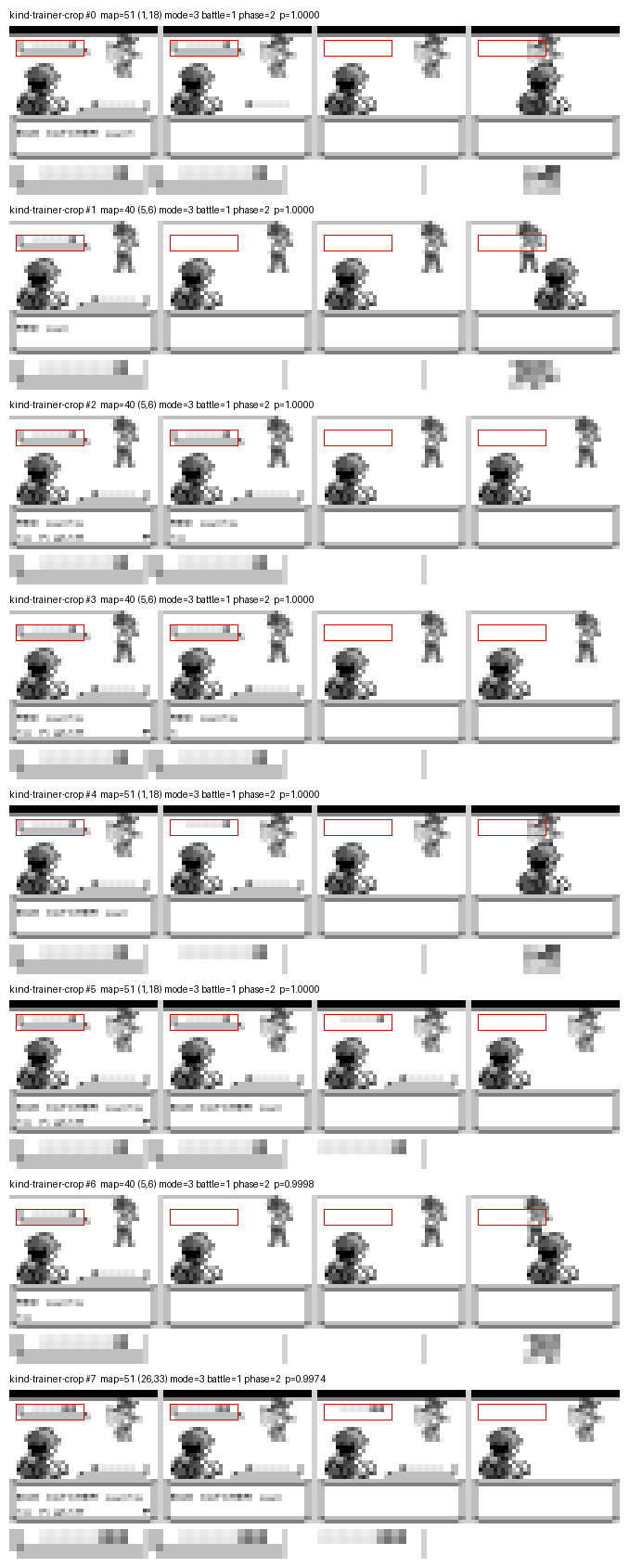
Two decisions later the row is gone and the same band carries the enemy HP bar, which reads identically in both kinds of fight. The signal exists only at the start: 346 of 346 recorded trainer battles show it, for a median of 2 decisions, range 2 to 2.
Cropped to that band, the recogniser fires on 0 of 1,019,244 probed frames at 0.95 while catching all 346 — and the probe deliberately includes three wild-battle corpora, where a fire would be a real mistake rather than an unseen scene.
The same argument, put more sharply, produced the heal trigger. The design note is worth quoting:
A declared region is a hard, structural restriction on what a recogniser can see, not a hope that a balanced corpus will make it ignore the rest.
The heal trigger's design note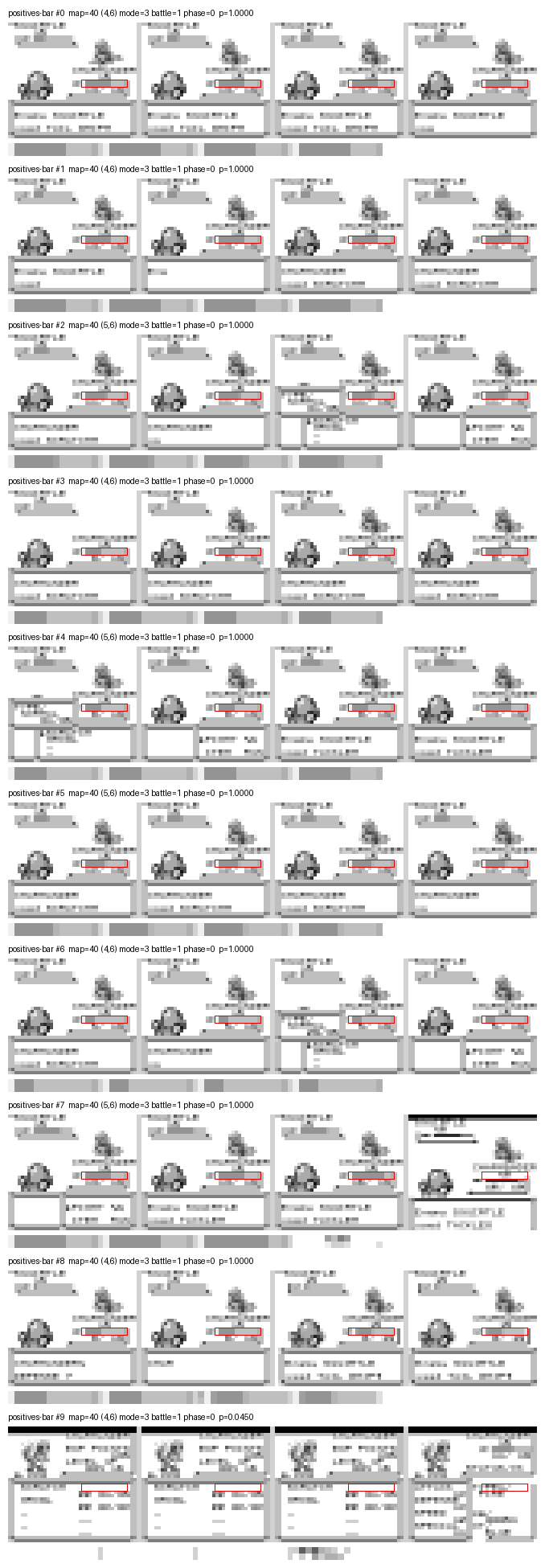
HP: label and the digits all sit
outside the box.
That crop is 24,082 parameters and cannot see the name or the level, by construction rather than by hoping.
It also cannot be trusted on its own. Ungated, it reads 33% of 1,898,768 real play frames as low HP — every one an overworld frame whose bar region is a patch of grass. The HP bar is only drawn during a battle, so the bar reading is only ever taken inside the battle gate above. Gated, twelve of twenty-four probe links contribute no frames at all, because none of them contains a battle.
Gated and measured against frames whose recorded HP already settles the answer: 42 false alarms in 71,482 frames across 24 links, 0.059%, with 1,035 of 1,035 genuine occurrences caught.
One thing that measured worse is worth the space, because it points the other way. Looking at the pile showed 84.1% of its 67,935 positives were gate-shut — the intro wipe, the stats sub-screen, the move list, none of them drawing a bar at all. Cutting them is obviously the right thing to do. Paired at the same seed and epochs, it takes held-out accuracy up, 0.9946 to 0.9997, and the false-alarm rate on the frames the trigger will really be asked about the wrong way, 0.48% to 1.73%. Held-out accuracy lied about the fix for held-out accuracy lying.
A trigger that holds must latch
The battle pair does not just fire; it holds the wheel until the fight ends. The first wiring asked the entry recogniser again every decision.
That cost the chain 9/30 down to 2/30. The rival fight fell to 19/30 and eleven runs of thirty ran out their budget standing in Oak's lab.
The reason, measured over real fights: the gate reads under its own entry bar on a large minority of a battle's frames — the attack flash, the move menu, the damage animation. Over 20,000 sampled battle frames it clears 0.999 on 31.4% of them in the rival fight and 41.6% on Route 1. Swept all the way down to 0.005, only 79–95% clear the bar; there is a hard core it reads as near-zero at any threshold. Its longest run of readings below 0.5 while the battle is genuinely still on is a median of 5 to 9 and a maximum of 16 consecutive decisions, which no single-frame bar can tell apart from a real ending.
So the marker fires once, latches, holds, and is released by a separate condition. Three changes, no retraining and no new weights: a latched group keeps the wheel whatever the gate currently reads; the release has to disagree 24 decisions running, half again beyond the worst observed 16; and entry and release are different numbers, 0.999 and 0.5. Using one number for both is what caused it.
The rival fight went back to 30/30 and stuck_in_battle from 26 to 1.
The entry recogniser only has to be good at the entry frame. It already was.
What actually worked
Crop tight. Every trigger cropped to a band — the text box, the ball row, the HP bar — passed on the first or second attempt. The two aimed at whole screens fought back for a night each.
Prefer the game's own words. Where the cartridge announces something out loud, match
the text and train nothing. The heal cycle disarms on Nurse Joy saying fightin — a
seven-character prefix, chosen so it catches the line while it is still being drawn, and
chosen over Thank you! because the shop clerk says that too.
Train simple, probe broad, patch narrow. Start with the scene's own non-scene frames as the negative class and nothing else. Probe everywhere. Add only the areas measured to be confused. The alternative is mapping the entire game as no.
Refuse. If no threshold satisfies both bars, ship nothing.
Where it stands
Nothing in the config the student now runs reads cartridge memory. Of its twelve goals, eleven fire from pixels through a recogniser and one fires on a line the game prints on screen; two of the eleven also stand down on a printed line. No map reads, no battle byte, no HP struct.
The forest crossing over the two days, all N=30 cold boots on the same config, seed 42:
| Change | Crossings |
|---|---|
| forest trigger on the screen, hold evicted by other goals | 0/30 |
| hold made to survive another goal's decision | 4/30 |
| heal trigger rebuilt, having fired 383 times inside the forest | 9/30 |
| battle triggers on the screen, hold re-checked every frame | 2/30 |
| battle triggers latched | 8/30 |
| heal chamber moved to the HP bar | 12/30 |
The last row carries its own caveat: paired over the same 30 seeds the heal change
gained 8 runs and lost 4, which at this sample size is not a proven improvement (McNemar
exact p=0.39). What it did establish is that the trigger now fires when it should —
go-heal-center went from firing in 20 of 30 episodes to 29, and every one of those 29
ended at Viridian's own counter.
The third row is the one to notice. A trigger firing where it should not does not just misbehave locally — the heal trigger was firing 383 times inside Viridian Forest, a room with no Pokémon Centre counter in it, and evicting the forest walking lesson 22 times. It was the single largest cause of the crossing failing, and the fix was in a different goal entirely.
And the honest comparison: the same 25-link config with all five cartridge reads still in place crossed the forest in 41 of 60 agents. Screen-only currently costs ground.
That is not a like-for-like measurement — 60 agents against 30 runs, and the two seed their attempts differently — so read the direction and not the size. The direction is clear enough, and it is the price of the constraint rather than an argument against it. A trigger that reads the cartridge cannot leave the building.
Every figure here is N=30 or smaller against a project convention of 3,000 attempts. These are screens, not certifications.
One command
All of this is now agentgb trainscene: select the positives, train, probe real play,
sweep the threshold on both sides, and print a registry entry — or refuse.
It refuses by default if a trigger fires even once where it should be silent, because a trigger behind a hold strands the whole run on a single false positive. It refuses if any genuine occurrence is missed, counting occurrences as episodes rather than frames, so a long fully drawn tail cannot carry a trigger that misses every half-drawn entry.
It refuses in practice and not only in principle. The first trigger it was ever pointed at in anger — the Pokémon Centre counter — came back refused on round one, with 21 of 22 probed areas firing.
Rebuilding the forest-entry trigger with it, natural negatives alone: held-out balanced accuracy 1.0000, and 21,295 false alarms in 1,751,142 frames, 1.2% even at 0.999. Refused, with 21 of the 23 probed areas named and the flag to paste back printed underneath. With those negatives added: zero false alarms at every threshold from 0.8 to 0.999, all 150 crossings still caught, the weakest at p=0.999974. Three and a half minutes.
The other half is not a command. Dump the positives, look at the montage, and ask whether every row is the thing you meant. It has now caught three poisoned piles where every number said clean, and a person spotted each of them by eye.
The figures here come from AgentGB's own run records and trigger studies of 2026-09-02 and 03 — docs/battle-screen-trigger.md, docs/trainscene.md and docs/goalnet.md, with the forest-walk-npcbox, go-heal-center and heal-at-the-counter-goal entries in data/transitional-goals.json. The montages are drawn by tools/dump_recognizer_positives.py from the corpora each recogniser was actually trained on; game art is Nintendo/Game Freak's, and these frames are documentation of a measurement. The wider project, its methodology and its tooling are on the AgentGB project page.