Pokewalker · Creatures as data
A liquid turn
Our Pokémon can now turn round smoothly, through every angle, from just a front, a side and a back. The first attempt pulled Charizard's face off. The second snapped. The third pours.
The creatures on the walker are made of maths, and lately they move like it too. But each one only has a few real views: a front, a side and a back. The other side is the first one mirrored. That is all an artist ever drew for a follower, and it is all we have.
So when the camera swung round a creature, it cut from one view to the next. Nidoking would be side on, and then, one degree later, he would be facing you. A little blip, every quarter turn. It's fine on a sprite that never moves the camera. It looks awful in a park you can walk round.
First try: move the parts
The creature is already built from parts: a head, a body, arms, a tail. So the obvious idea was to turn each part on its own, slide it round the body, and let them overlap properly.
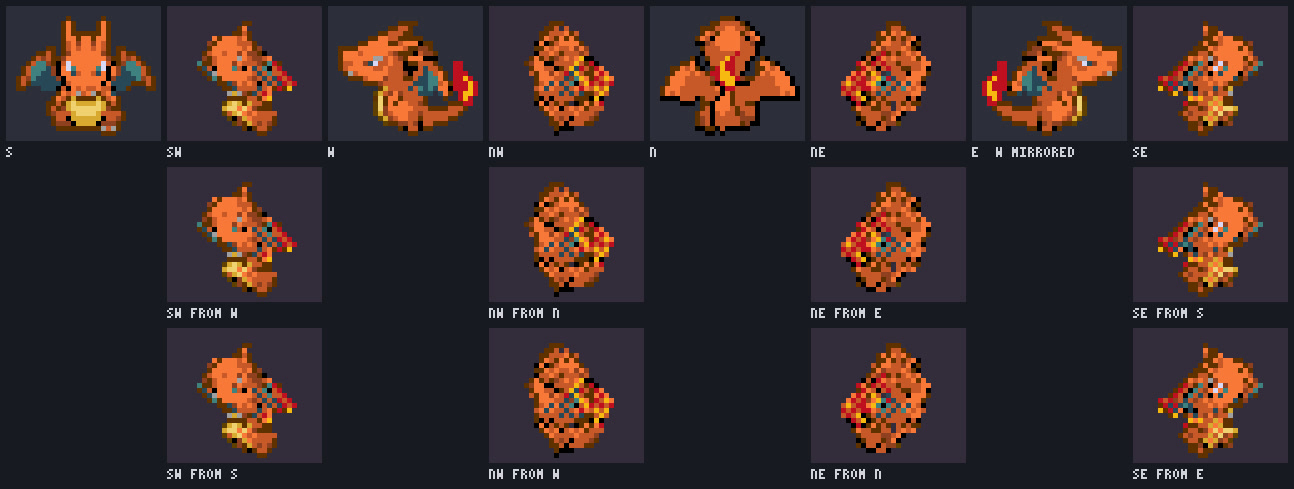
It pulled his face off. The parts were cut out of a flat drawing, so they have no idea how deep they are. Turn them and the snout drifts away from the head, and the head drifts away from the neck. Watch the left-hand Charizard for a bit and it gets quite upsetting.
Second try: a relief
So stop thinking in parts and think in bodies. Take each view and lift it into a shallow relief, row by row: as wide as this view's ink, and as deep as the neighbouring view's ink. The side view tells you how deep the front is, and the front tells you how deep the side is. Turn that with a depth buffer and you get one solid body, not a pile of stickers.
That was much better, on the right above. But each relief is still only good near its own view. At some point you have to hand over from the front's relief to the side's, and at the handover the outline snaps. A smaller blip, but still a blip.
Third try: pour it
Now the turn is liquid. At any bearing, both neighbouring views are turned to face the camera. Each one becomes a distance field: for every pixel, how far it is from that view's outline, inside or out. The outline drawn on screen is where a blend of the two fields crosses zero, and the blend eases across the whole quarter turn. The shape pours from one silhouette into the next, like filling a Pikachu-shaped bottle.
Colour is the fiddly part, because a blend of two colours is a colour neither drawing has, and the whole point of these creatures is crisp pixel art. So each pixel looks up the matching spot in both views, by how far down the row it sits, and takes one of the two real palette colours. Which one it takes switches over on a Bayer pattern, so the change sweeps across the body as a staggered dither rather than a smear. Every pixel on screen is still a colour the artist chose.
Nothing in between is stored. There is no diagonal drawing of Charizard anywhere. The 45° view, the 37° view, the 3° view are all worked out live, every frame, from those three drawings.
Did it work?
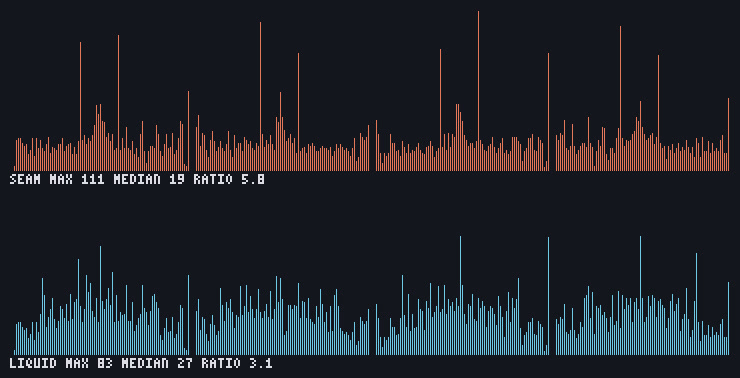
To put a number on "snaps", I turn the camera one degree at a time and measure how much of the picture changes each step. A smooth turn changes a bit every step. A snap is one step that changes far more than the rest. So the score is the biggest step over the typical one.
| Biggest step ÷ typical step | Seam | Liquid |
|---|---|---|
| Charizard | 5.4 | 3.1 |
| Nidoking | 5.8 | 3.1 |
| Charizard in battle | 4.6 | 2.9 |
The spikes are gone. The honest cost is in the graph too: the blue baseline is a bit busier, because the dither is always shimmering a little somewhere while the body pours. I'll take a gentle shimmer over a blip every quarter turn.
It's all integer maths with no allocation, the same rules as the rest of the creature code, so it can run anywhere the walker does. Next it goes into battles, the park, flight and the shorts, wherever a camera gets to move round a creature.
Every Pokémon here is the walker's maths version, drawn from shapes and bones. The sprites they were built from come out of the owner's own cartridges at build time and no repository stores them. Pokémon is Nintendo's.
← Back to devlog