Pokewalker · Creatures as data
Moves are numbers too
Charizard used to fly by swapping two pictures. Now it crouches, throws itself into the air, beats its wings to climb and leans into its turns, and none of that is a drawing. It is a few hundred numbers saying how far each bone turns, and when.
That is the real park flight, the same code the browser walker and the portal run. The only thing new in it is what Charizard knows how to do.
A move is a curve, not a flipbook
The creatures on the walker are made of maths: outlines, a skeleton, and moves. A sprite animation stores every frame as pixels. A move here stores none. It is a set of curves, one per bone, saying how far that bone is turned at each moment, plus the odd nudge or squash. Those curves live inside the creature's own file, next to its shapes.
Every frame the walker asks "where is every bone at 1,240 ms?", poses the skeleton and draws the outlines fresh at 1x, on the creature's own pixel grid. That has a few nice side effects. A move plays at any speed and any frame rate, because time is continuous and there are no frames to drop. Two moves can be faded into each other, because halfway between two angles is just another angle. And a move costs a few kilobytes at most, not a sprite sheet.
Three ways to make one
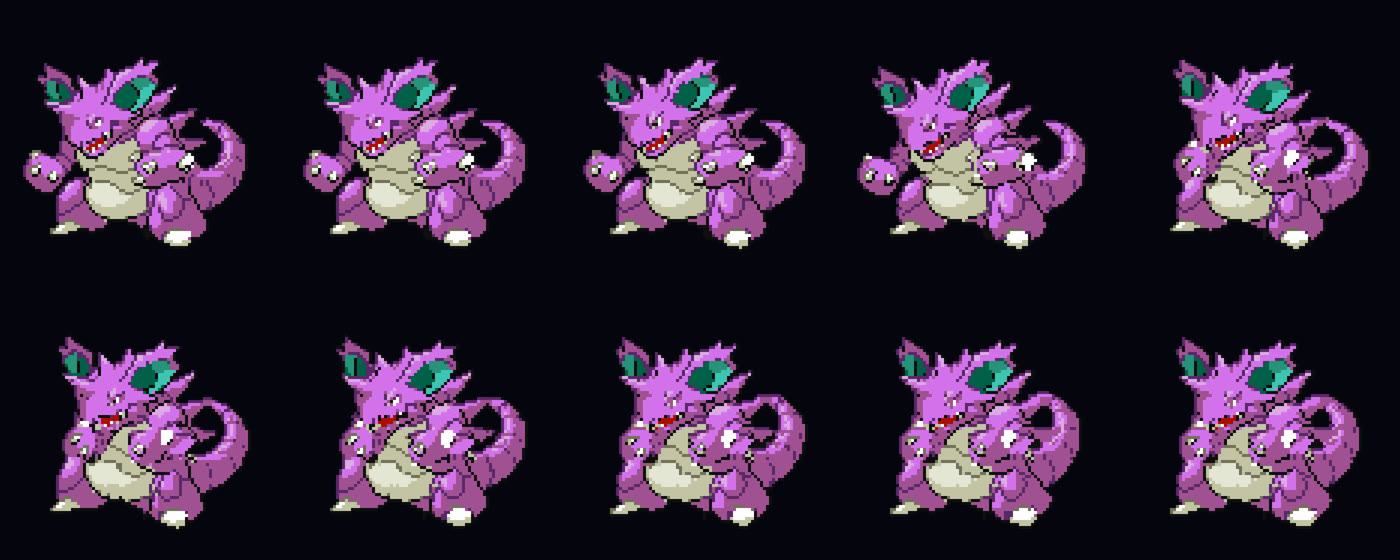
By rule. Every creature gets a set of moves the moment it is made: idle, hop, attack, a look round, a tail swish. They are built from the skeleton alone, so they work on anything with a tail or a head. Nidoking's tail used to sit still while he idled. One command folded a swish into his idle, twice as big and lagging down the tail so the tip follows the base:
make swish --into idle --gain 2 --lag 14. Left: before. Right: the tail sways.By hand. Rules are good at loops. They are bad at a single moment with weight in it. For those I set a handful of keys on the bones and let the easing do the rest. Nidoking's brace is 150 ms of snap: a little anticipation first, then the body snaps back past where it ends up and settles, the arms pull in, the back arches, the knees flex and the feet stay planted. Every one of those is a few keys on one bone.
From a motion model. Today's earlier post was about Kimodo, which writes a human movement from a sentence. Its sibling MotionBricks does two things Kimodo can't: steer a walk towards a target, and fill in the motion between two poses I choose. Neither of them ever draws anything. What comes out is a skeleton's joints moving over time, which gets filmed from the side, front or back, turned into angles on screen, and mapped onto our bones.
The sheets below show the whole trip in one picture: the human skeleton, the same moment laid over the creature's rig, the creature playing it, and what actually gets stored, one curve per channel.
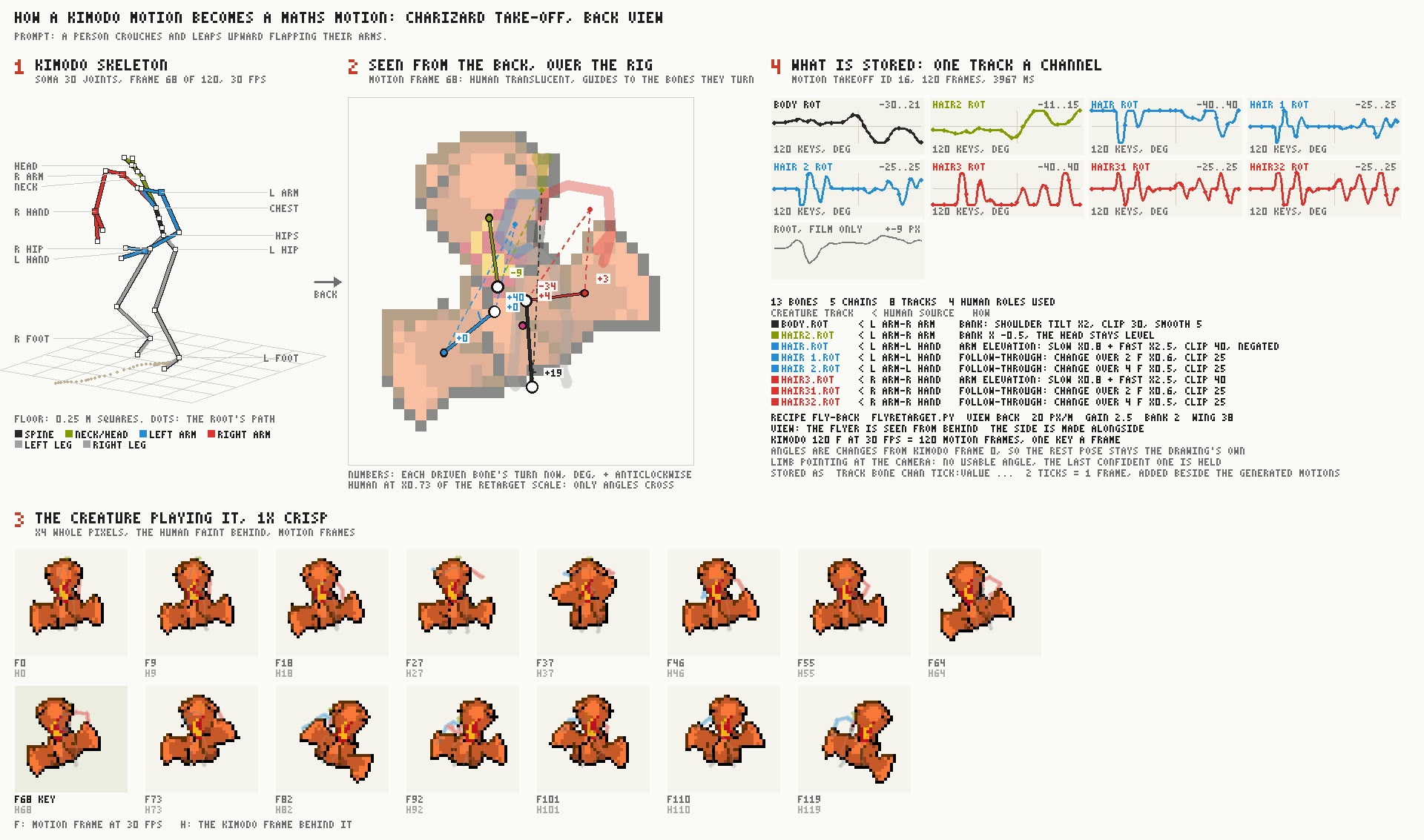
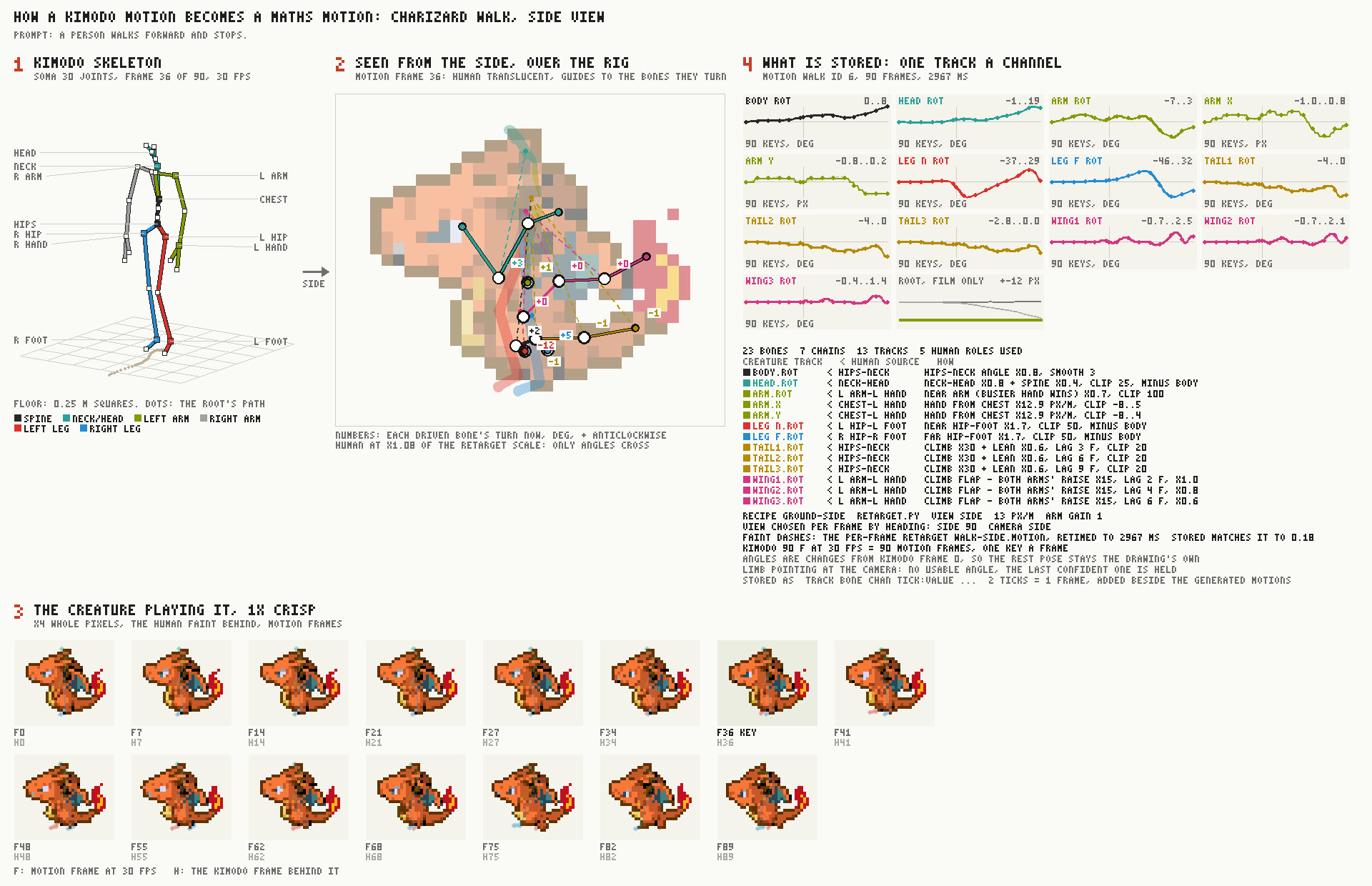
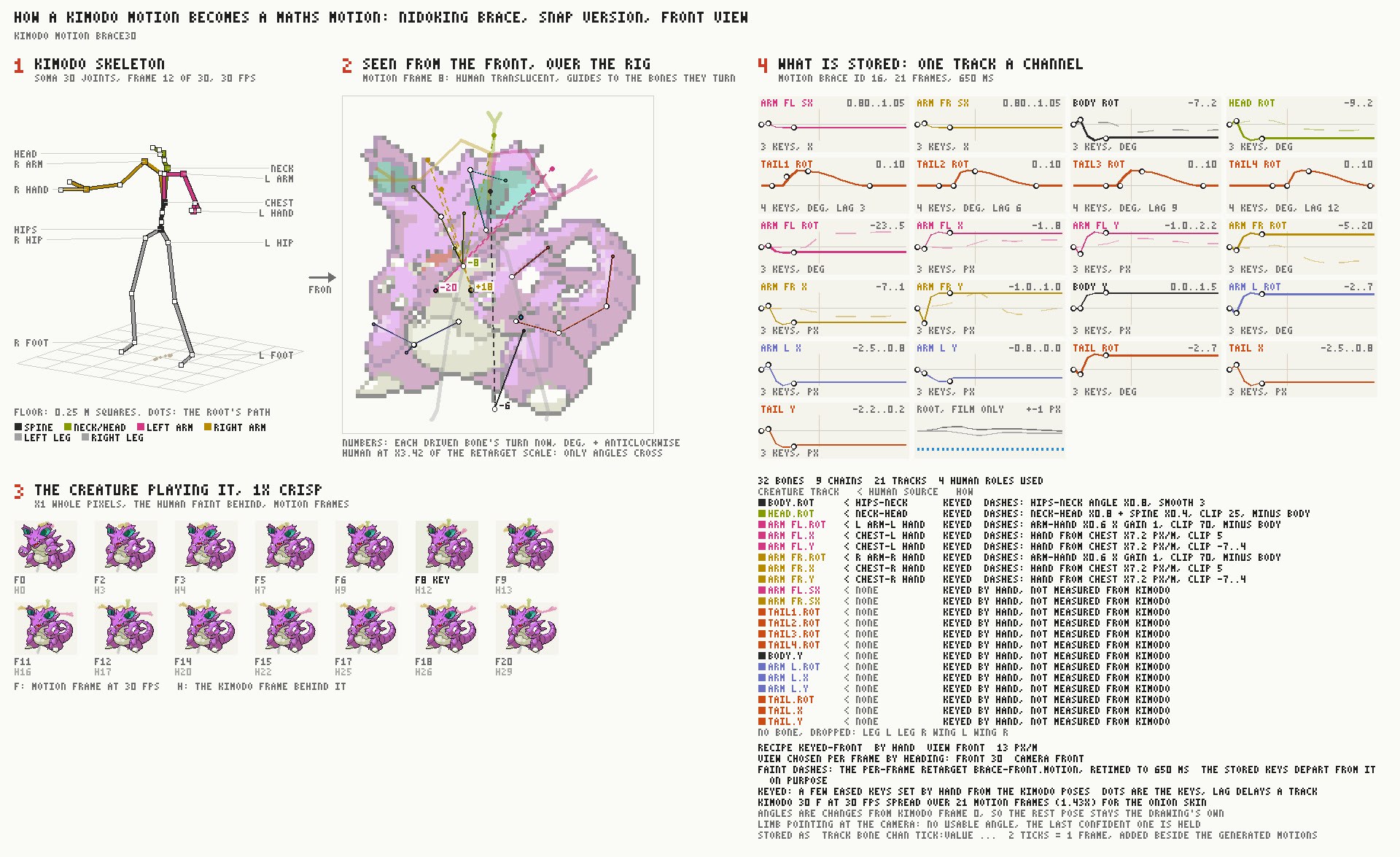
That last one is how the methods actually get used together. The model is good at timing and weight. A few keys by hand are good at exaggeration, which a real person bracing doesn't do and a cartoon dragon should.
Keeping them
Creatures get remade. The tracer improves, an eye gets fixed, the skeleton finder learns something, and the whole creature is built again from its sprites. A move that only lived in the old file would be gone.
So moves that matter are kept as a log: a short text file of the motion commands that made them. Every remake replays the log on top of the fresh creature, so the moves come back on the new skeleton. For a creature that is already committed, a replay can add the logged moves to one view, Charizard's back, and leave every other byte of the file exactly as it was. That is how the flight moves went in without touching anything else Charizard does.
The flight moves also have fixed numbers: takeoff is 11, flap 12, glide 13, bank 14 and a barrel roll 15. Bank is a scrub rather than a loop: fully left at its start, level in the middle, fully right at its end, and flight plays it at whatever angle the turn wants.
It reaches the game
Flight looks for those numbers. A flyer that has them takes off with its takeoff, beats its wings while it climbs or hurries, glides when it is level, fades between the two, and leans into turns with its own bank instead of the whole picture tipping. A flyer that has none flies the way it always did. Charizard is the first to have them. Any creature given the same five moves gets the same treatment, with no change to the flight code.
What doesn't work yet
The walker's followers are 32 pixels tall, so arms are three or four pixels. A punch or a wave moves almost nothing. Whole-body moves read; small-limb moves mostly don't.
Some limbs are still split out by hand. The generated skeleton sometimes keeps a leg as part of the body, and then there is nothing for a stride to turn. Splitting limbs automatically is being built now.
The turn between views isn't smooth yet. A creature going from side-on to facing away still cuts from one drawing to the next, and a proper turn is in progress.
Every Pokémon and every scene here is the walker's maths and placeholder art. The sprites the creatures were built from come out of the owner's own cartridges at build time and no repository stores them. Pokémon is Nintendo's.
← Back to devlog