AgentGB · Method
A perfect score and 361,567 false alarms
Every recogniser in AgentGB is a two-class network answering one question about the picture on screen. The cheapest way to be wrong about one is to trust the score it prints. On 2026-09-03 the same mistake was made twice in one day, caught twice, and the way it was caught both times was somebody dumping the frames out and looking at them.
The recogniser had one job: say whether the player is standing in Viridian City. It is the sight half of a give-back — lose a fight in Viridian Forest, the cartridge blacks the party out two maps away, and the lesson the run had earned is thrown away with it. Hold that lesson instead, and hand it back the moment he is somewhere it knows.
It scored a held-out balanced accuracy of 1.000.
Then the probe swept it over 1,383,924 frames of real play from 21 links it had never been trained on. At 0.999 — the tightest threshold in the sweep — it fired on 361,567 of them. Twenty-six per cent. It had learned to say yes.
That is not bad luck, it is the shape of the question. A closed two-class network puts everything it has never seen into whichever class is broader, and the held-out split is drawn from the frames it was shown, so it cannot contain that failure by construction. Ask which place is this and the broader class is the positive one.
Five rounds, and the one that made it worse
agentgb trainscene refuses by default. It sweeps both bars at every threshold — the pooled
false-alarm rate over real play, and how many genuine occurrences are still caught, counted as
episodes rather than frames — and if no threshold satisfies both it ships nothing and prints
the areas it is confused by. Five rounds of that:
| Round | Negatives | False alarms / 1,383,924 at 0.999 | Verdict |
|---|---|---|---|
| 1 | natural only | 361,567 · 26.13% | refused |
| 2 | +15 links, 400 rows each | 2,570 · 0.186% | refused |
| 3 | the refusal's own printed flag | — | killed |
| 4 | +13 links, 3,000 rows each | 5,257 · 0.380% | refused |
| 5 | positives narrowed to mode=0 | 12 · 0.0009% | pass |
Every reported round caught 1,500 of 1,500 genuine occurrences. Round 4 is the one to look at: thirteen more areas of corrections, seven times as many rows each, and it came out worse than round 2.
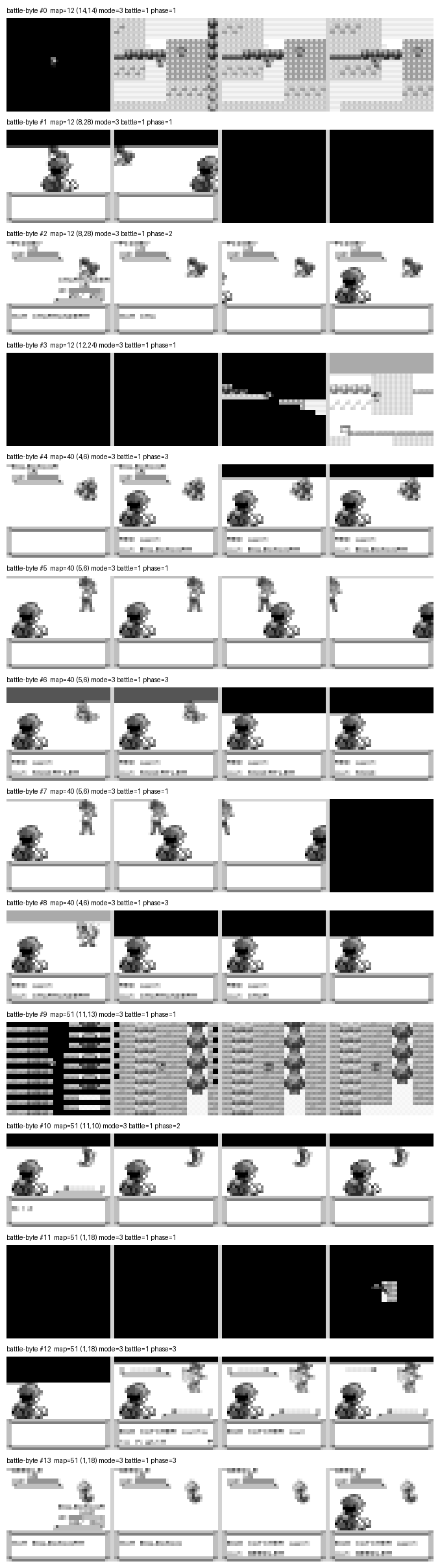
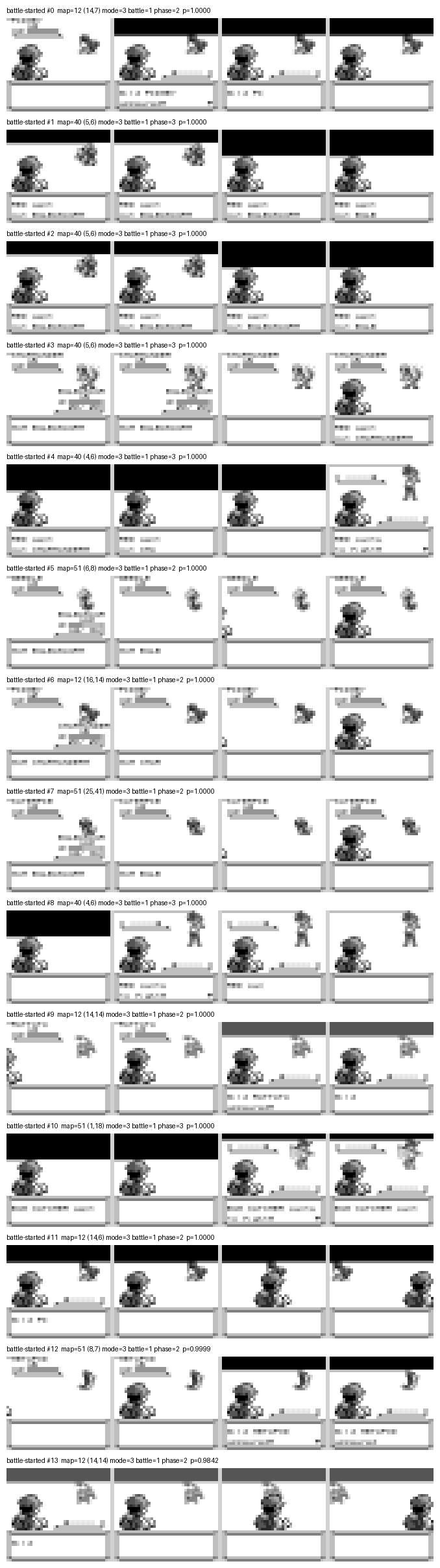
So the residual got dumped as a montage and looked at. Ninety-two per cent of it was one screen — the nickname naming grid, map 40 at tile (5,3). A grid of dark glyphs on a light field, which at 40×36 is a town. Four rounds of arithmetic had not said that, and no aggregate was ever going to.
Chosen by the byte · poisoned
Chosen by the phase · honest
The Viridian fix was the same move. Positives narrowed from every frame on map 1 to
map=1,mode=0 — the town outdoors, with a menu drawn over it no longer counting as the
town. 94,409 frames over 527 tiles.
That took it to 12 false alarms in 1,383,924 frames, 1,500 of 1,500 occurrences still caught, weakest genuine fire at p=1.000000. Eleven of the twelve are on one link and the twelfth is inside the Viridian Mart. Threshold 0.999 rather than the command's recommended 0.99, which is a deliberate departure: the take-the-lowest rule exists because the Game Boy draws text letter by letter and a tight trigger goes blind on a half-drawn line, and a town is not drawn progressively. Twelve frames against 251, identical recall.
The tool poisoned its own round
Round 3 is missing from the table because it was killed rather than reported.
When trainscene refuses, it names the areas that fired and prints a ready --negatives flag
listing them. Pasting that flag back in is the obvious next move, and here it was the wrong
one: --negatives takes whole episodes, with no selector. Three of the links it named are
Viridian City almost end to end — into-the-viridian-mart is 99.0% map 1,
north-out-of-viridian 98.8%, into-the-pokemon-center 98.7%.
So the scene being recognised went into the no pile. About 18% of that round's negatives were the thing itself. Held-out balanced accuracy fell 1.000 → 0.927 and stalled, and the round was abandoned.
The probe was not wrong to name those links — it scores them only on their out-of-scope frames, correctly. The advice it prints from that is what does not survive contact with a link whose corpus is mostly the scene. Check a patch link's own map distribution before pasting.
Zero false alarms, then 41 in a town
The forest-entry trigger, built the day before, had the cleanest numbers on the project: 150 of 150 real crossings caught at 0.999, and zero false alarms pooled over 495,902 frames across 23 corpora — including a shard of cross-map door fades collected on purpose, because a link's corpus stops at its map change and the next one starts after it, so the states a run passes through in between exist in no ordinary corpus at all.
Then a 30-run cold-boot arm came back with forest-walk-npcbox firing 41 times on map 1,
Viridian City. It was the last goal driving in 16 of the 18 failures, and 15 of the 18 ended
inside the Viridian Mart at the full 8,660-decision budget, pressing left.
That reads exactly like a false positive, and the structural argument above says a probe cannot rule one out. Two crews landed on that goal independently on the same day.
It was innocent
The way to check is to stop probing corpora and score the recogniser on every decision of real
play instead. harvest_goal_false_positives.py replays a sweep's recorded attempts through the
same functions a measured run uses, wraps the driver, and writes out the stacks a named goal's
recogniser actually fires on outside its own maps. Eighteen replayed failing attempts, 155,880
decisions:
| Where | Decisions | Peak probability |
|---|---|---|
| Viridian City | 3,278 | 0.0408 |
| Inside the Viridian Mart | 100,728 | 5.4e-05 |
| Viridian Forest | — | 0.99996 |
On the one traced seed, the two Viridian decisions it was recorded as "firing" on read 7.7e-17 and 8.9e-08. All 30 episodes' first fire is on map 51, and no episode fires outside the forest before entering it.
The recogniser never fired in the town at all. A fired event in the run record cannot tell a
threshold being cleared from a persisted hold resuming, and that one ambiguity is what made
a mechanical bug look like a perception one. A retrain would have changed nothing.
One real risk did fall out of the harvest, and it is worth naming. The only readings above 0.5 anywhere outside the forest are fifteen, all in Oak's Lab, peaking at 0.9576. Dumped and looked at, they are the same shape as the entry positives: a solid black transition frame in the oldest channel of the stack, beside a light textured region and a text box. Which is what that positive class is made of — 150 near-identical frames of one tile, (17,46), with the camera clamped at the forest's southern edge so the lower half of every one is black. It is safe today because the threshold is 0.999 and not 0.95. That is a thinner margin than anybody knew they had.
The fault was mechanical
end_condition.persist_through_other_goals exists because a hold that spans a long stretch of
play loses the wheel the moment anything else wins a single decision; without it the forest
crossing scored 0/30. As first written it made a hold survive the decisions it does not drive,
and left its ending observable only on the ones it does.
Lose a Bug Catcher fight inside Viridian Forest. The cartridge blacks the party out to Viridian City while the battle hold is driving. The forest hold is asked nothing, the battle hold releases at map 1, the forest hold resumes — and the forest's own walking adapter drives the run around a town it has never seen for the rest of its budget. The event immediately before every single non-forest fire is a battle hold releasing at map 1 or 0: fourteen trainer battles, one wild.
The version this trigger replaced was gated on wCurMap and was immune by construction. It
re-asked memory every decision, so a teleport stopped it on the next one. Moving to the screen
removed the memory read and quietly removed that property with it. When a mechanism replaces
a memory read, check which properties the memory read was silently providing.
The replacement needs no weights. release_on_text sweeps a list of phrases at the top of
every decision, before selection, for every persisted hold. A list rather than one phrase,
because a decision samples one frame in 32 and the game draws a line letter by letter:
BLUE is out of / useable POKéMON! is up for two sampled decisions, BLU for one mid-draw,
and BLUE blacked / out! fully drawn for about one. Two phrases give roughly four decisions of
cover instead of one.
Paired on the identical 30 seed pairs, cold boot, seed 42:
| Whole chain, 30 cold boots | Crossings |
|---|---|
| persisted hold, no way to end it while evicted | 12/30 · 40.0% |
| hold released on the blackout line | 25/30 · 83.3% |
Thirteen gained, none lost, McNemar exact p = 0.00024. Milestones 1 to 24 are 30/30 in both arms, and the change is provably inert where no blackout happens: all 12 runs that already finished reproduce their exact decision count, 12 of 12, median 2,165.5 either way. Fires on map 1 went 41 → 0; all 270 fires are on map 51; the first fire is on map 51 in 30 runs of 30. The trigger everybody suspected was never touched.
Of the five that still fail, four are stuck in a forest battle — no PP left, no running from a trainer battle — which is a known gap in fighting competence and not this bug. The fifth released correctly at the blackout and then wandered into the Mart under a different latched lesson.
What the day cost
The give-back that started all of this measured a null, and it is recorded as one. Seven recorded knockout seeds: 2/7 through the forest with no clear, 2/7 clearing, 2/7 clearing and handing back — the same two seeds every time. Thirty cold boots, paired: 12/30 both arms, zero gained, zero lost, every one of the 25 milestones identical.
The mechanism itself is clean. Fifteen of the 30 runs got the lesson handed back, every restore on map 1 and on that stage alone, zero false hand-backs, zero runs ending still-held. It fires correctly, costs nothing, and rescues nothing at this sample size, because the thing ending the runs was three maps away in a branch of code with no weights in it.
Five training rounds bought a recogniser that works and does not currently matter. Finding that out is what made the next fix a one-line declaration.
The sequence
This is now the written procedure rather than something the crew happens to do.
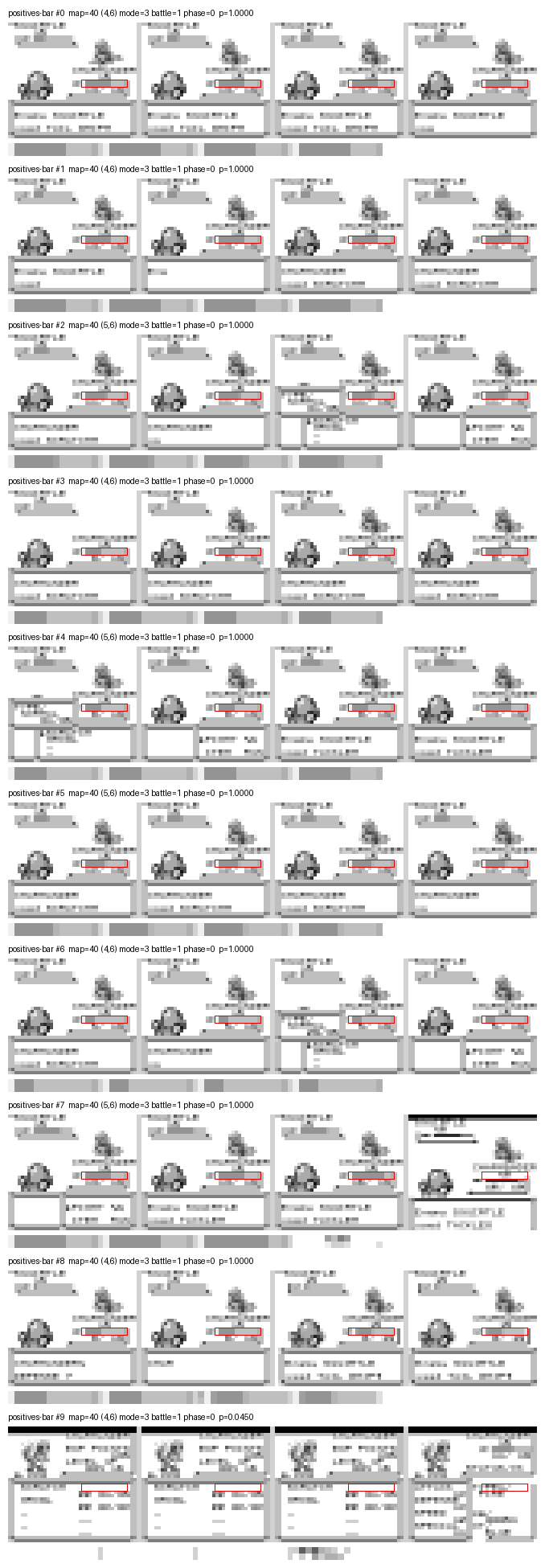
1. Dump the positives and look at the montage before training. Not a description of them — the actual four-frame stacks, in a picture, in front of a person. It has now caught a poisoned pile three times where every number said clean.
2. Small cheap tests first. A tile distribution, a map histogram, one probe over one link. An hour of training is a bad way to discover a bad idea.
3. Let the tool refuse. A trigger that fires where it should not is not a trigger. The default false-alarm bar is 0.0 because a trigger behind a hold strands the whole run on one false positive — relax it deliberately, on evidence, and say so. This one was relaxed to 0.0005, on the argument that the exposure is bounded by where the code can ever ask.
4. Narrow what it learns from before piling on corrections. Rounds 2 and 4 added 28 links
of negatives between them and left 5,257 false alarms. Adding mode=0 to the positive selector
left 12. Every correction teaches the network another place it is not; a narrower positive
teaches it what it is.
5. Two aimed rounds, then stop and report the trade-off. Round 4 was the third and it went backwards. The stopping condition is not "it passed", it is "the next round has a reason".
6. Measure in a real run, paired, and report what was gained and what was lost. Both numbers. 13 gained and 0 lost is a result; 8 gained and 4 lost, which is what an earlier change on this same chain produced, is not.
And a seventh that only exists because of today: check who is driving before blaming what recognised. Forty-one fires in a town, sixteen of eighteen failures ending under that goal, and the recogniser's own peak reading there was 0.0408.
The figures here come from AgentGB's own records of 2026-09-03 — docs/transitional-goals.md, docs/trainscene.md, and the up-route-2-forest-goal-gate-npcbox and forest-walk-npcbox entries in data/transitional-goals.json, with the paired 30-run sweeps read back out of their own result JSON. The montages are drawn by tools/dump_recognizer_positives.py from the corpora each recogniser was trained on; game art is Nintendo/Game Freak's, and these frames are documentation of a measurement. The wider project is on the AgentGB project page.